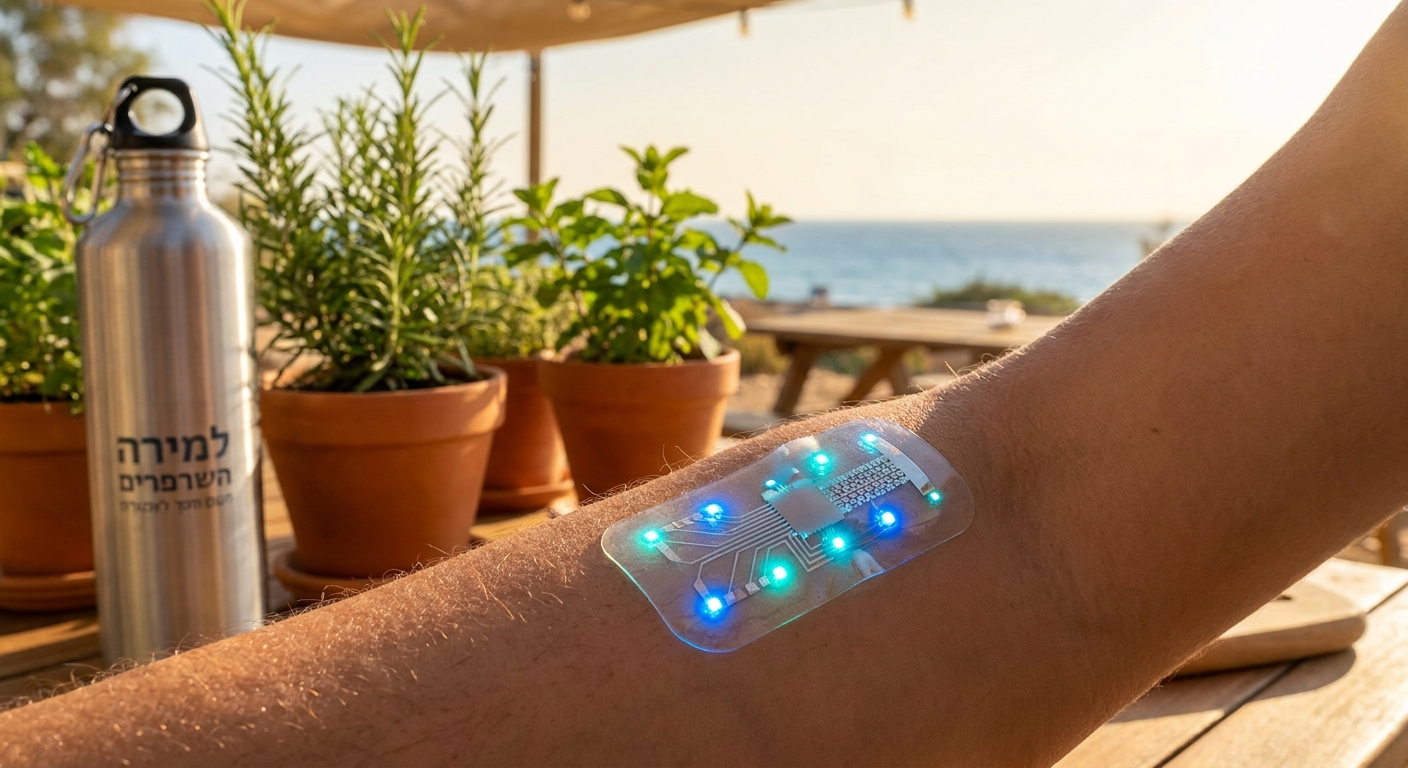
You know the feeling. You drank water all day, maybe even carried one of those giant motivational bottles, and by mid-afternoon you still feel headachy, foggy, oddly tired, and somehow both puffy and dried out. That is the annoying part of hydration. It is not just about volume. It is also about what your body is losing, especially sodium and other minerals, when you sweat in Tel Aviv heat, rush through airport terminals, sit on a long flight, or power through a stressful week on too little sleep. The new Israeli smart hydration patch is trying to fix that blind spot. Instead of counting steps, these skin patches track sweat and electrolyte trends in real time or near real time, then send simple guidance to your phone. The goal is not to turn you into a lab rat. It is to help regular people drink smarter, recover faster, and stop guessing why they feel off.
⚡ In a Hurry? Key Takeaways
- Israeli smart hydration patch technology tracks sweat and electrolyte loss, which can tell you more than a basic fitness band about why you feel drained.
- If you deal with heat, workouts, fasting, flights, or stress, start by using a patch to spot patterns, then adjust water and electrolyte intake based on those trends.
- These patches are helpful wellness tools, not a replacement for medical care if you have kidney, heart, blood pressure, or serious dehydration issues.
What these patches actually do
Let’s keep this simple. A smart hydration patch sticks to your skin like a bandage or sports patch. As you sweat, tiny sensors inside the patch read chemical markers in that sweat. Most focus on sodium first, because sodium loss is one of the biggest reasons plain water does not always make you feel better.
Some versions also look at potassium, chloride, skin temperature, sweat rate, and fluid loss trends. A connected app then turns those readings into something useful. Think: “You are losing a lot of sodium today,” or “You may need fluids sooner than usual,” instead of a page full of science jargon.
That is why the Israeli smart hydration patch story matters. Israel already has deep roots in sensors, medical devices, and miniaturized hardware. So it makes sense that local labs and startups are pushing beyond heart rate and sleep scores into something more practical for everyday life.
Why regular wearables miss this problem
Your smartwatch can be great at counting movement. It can estimate calories. It can buzz if your heart rate climbs. But it usually cannot tell you what is leaving your body in sweat.
And that is the missing piece.
Two people can do the same workout, sit in the same heat, or take the same flight and feel completely different afterward. One is fine. The other gets dizzy, crampy, exhausted, and cranky. The difference may not be fitness. It may be sweat chemistry.
That is where these patches stand out. They are trying to measure the body’s actual output, not just the motion around it.
Why this matters in Israel and for the diaspora
Hydration sounds boring until it is your whole day. In Israel, heat, humidity, dry air, beach days, school pickup, reserve duty, packed buses, and long walking commutes all add up. For diaspora readers, the same thing happens during summer travel, synagogue events, family trips, and marathon workdays.
Then add stress. Add coffee. Add sleep debt. Add salty food one day and not enough food the next. Suddenly “drink more water” starts sounding a bit childish.
What people really need is better feedback. Not more guilt. Better clues.
How an Israeli smart hydration patch can help in real life
1. Heat waves
When the weather turns brutal, most of us either underdrink or overdo plain water. A patch can help show whether you are also burning through electrolytes, especially sodium.
2. Long flights
Flying dries you out fast. Cabin air, bad sleep, salty snacks, coffee, and skipped meals can leave you wiped out before you even land. A patch cannot make economy class pleasant, but it can help you understand your hydration pattern before and after travel.
3. Workouts and walks
You do not need to be a marathon runner. Even a hard treadmill session, a hike, or walking outside in summer can produce meaningful fluid and mineral loss.
4. Fasting or irregular eating
If your routine includes fasting periods or missed meals, electrolyte balance can get messy. More information helps you avoid guessing.
5. Brain fog by 3 p.m.
This is the one many readers will care about most. The patch is not promising genius-level focus. But if your afternoon slump is partly tied to dehydration and mineral loss, seeing that pattern can be genuinely useful.
What is coming out of Israeli labs
Israeli health tech has a habit of taking hospital-grade ideas and shrinking them into consumer-friendly tools. In this case, that means biosensors, flexible materials, skin-safe adhesives, and phone apps that turn raw data into clear advice.
Some teams are working on disposable patches for short-term use. Others are testing reusable sensor systems paired with replaceable adhesive layers. The race now is not just accuracy. It is comfort, affordability, and making the readings easy enough for normal people to use.
That last part matters. If the app feels like chemistry homework, nobody will stick with it.
What the data may tell you, and what it may not
This is where it helps to stay grounded.
A smart hydration patch may help you see trends such as:
- How much you tend to sweat in certain conditions
- Whether you are a heavy sodium loser
- How travel, stress, heat, or exercise affect your hydration needs
- When plain water seems enough, and when it may not be
But it may not give perfect, minute-by-minute truth in every situation. Sweat sensing is improving fast, but the body is complicated. Readings can vary based on patch placement, skin condition, exercise intensity, and calibration.
So think of it as a good dashboard. Not divine revelation.
Who should be most interested
You do not need to be a biohacker.
These people are likely to get the most value:
- People who work outdoors or commute in heat
- Frequent flyers
- Parents chasing kids in hot weather
- Runners, cyclists, and gym regulars
- People who often wake up feeling dehydrated despite drinking water
- Anyone whose skin, mood, or focus falls apart in dry heat or heavy air-conditioning
That last point is not trivial. Hydration affects how your skin looks and feels, too. If you are already thinking about heat stress from the outside in, you might also like From Haifa Labs to Your Bathroom Shelf: The Israeli ‘Cloud Skin’ Serums Turning Sun‑Stressed Faces Into Camera‑Ready Glow, which looks at another practical way Israeli labs are tackling what heat and dryness do to everyday life.
How to use one without making your life more complicated
The best use case is not wearing a patch every waking hour forever. It is using it in smart windows of time.
Try it during a “problem day”
Wear it on a day when you usually feel rough. A hot commute. A travel day. A hard training day. A deadline-heavy workday with lots of coffee. That gives you more useful data than a lazy Sunday indoors.
Watch for patterns, not one-off blips
If one reading looks odd, do not panic. If the same pattern keeps showing up, pay attention.
Adjust one thing at a time
Try more water first. Then, if needed, try a balanced electrolyte drink, saltier food, or timing your fluids earlier. If you change everything at once, you will not know what helped.
Use your common sense too
If you have dry mouth, dark urine, dizziness, muscle cramps, or pounding fatigue, those clues still matter. The patch should support your judgment, not replace it.
What to look for before buying
Not every patch will be equally useful. Here is what matters most.
Clear readings
If the app gives confusing charts with no plain-language summary, skip it.
Comfort
If it peels off when you sweat or irritates your skin, it will end up in a drawer.
Meaningful metrics
Sweat rate and sodium are often the most practical starting points. More data is not always better.
Price per use
A cheap-looking patch can become expensive if it is disposable and needed often.
Privacy
As with any health-adjacent gadget, check what the company stores in the app and how it uses that data.
Important limits and safety notes
This part is important. If you have kidney disease, heart failure, uncontrolled blood pressure, or another condition where fluid and sodium balance is medically sensitive, do not self-experiment based on an app alone. Talk to your doctor.
The same goes for children, older adults with frailty, and anyone with signs of serious dehydration. A patch can help with awareness. It is not emergency care.
Why this feels different from another wellness fad
A lot of health gadgets ask you to care about numbers that do not change your day. This one could be different because the problem is so immediate.
If a hydration patch helps you avoid a headache, finish a workout stronger, land from a flight less wrecked, or stop that strange late-afternoon brain fade, people will notice fast.
That is the test. Not hype. Help.
At a Glance: Comparison
| Feature/Aspect | Details | Verdict |
|---|---|---|
| What it measures | Sweat rate and electrolyte trends, often including sodium, sometimes temperature and fluid-loss estimates | More useful for hydration than a step count alone |
| Best use cases | Heat waves, workouts, flights, stressful days, fasting periods, and dehydration-prone routines | Strong fit for real-world daily life, not just athletes |
| Main caution | Consumer patches show trends, not perfect medical diagnosis, and may not suit people with certain health conditions | Useful tool if you treat it as guidance, not gospel |
Conclusion
Hydration is quietly becoming a real daily vital sign, especially for people juggling heat, work, travel, family stress, and never quite enough sleep. That is why the Israeli smart hydration patch is worth watching. It takes a problem most of us feel but cannot measure, and turns it into something practical. Not perfect. Not magical. Just useful. By highlighting Israeli bio-sensing startups that are bringing lab-style sweat and electrolyte tracking closer to normal budgets, we give readers a way to protect focus, mood, and skin health without adding another exhausting routine. And that matters, across Israel and the diaspora, because sometimes the real win is simple. Feeling like yourself again before 3 p.m.