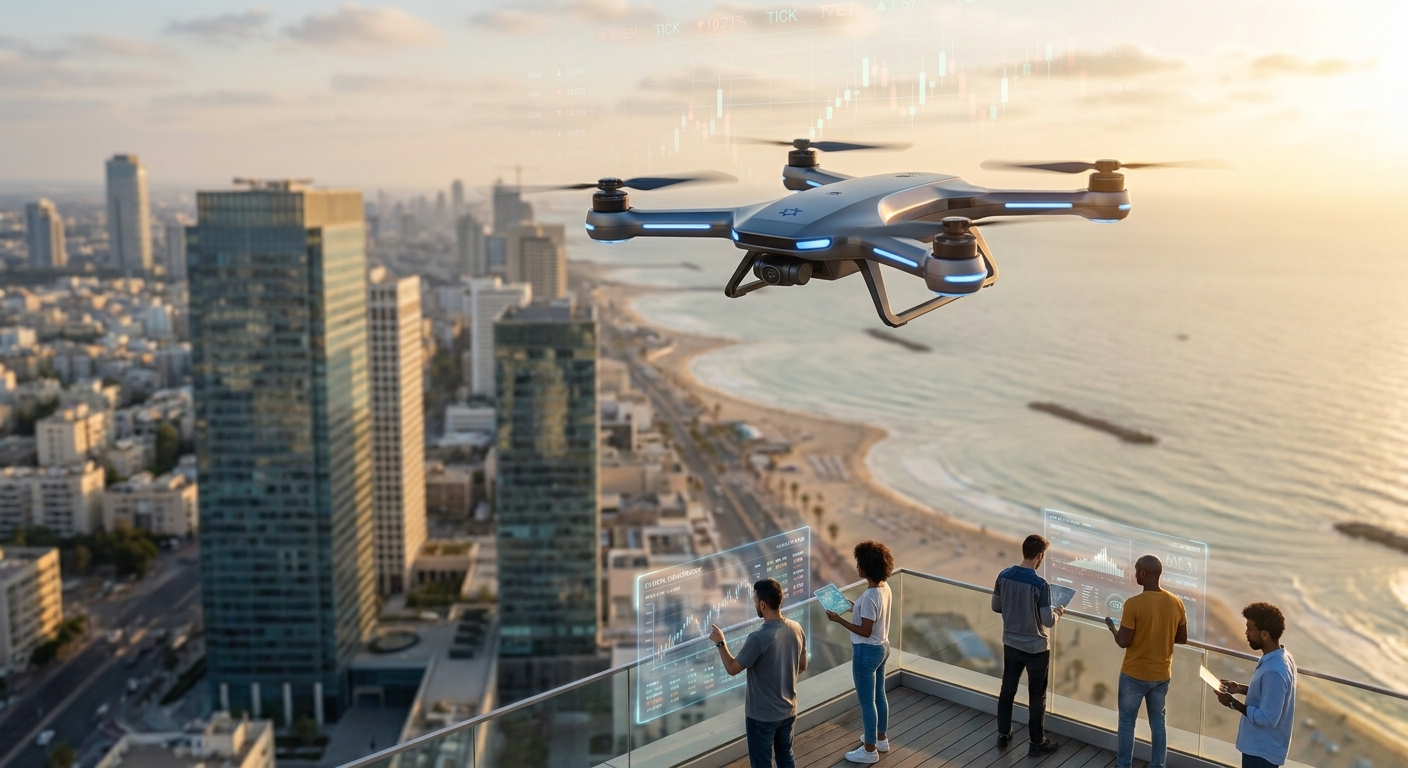
If you are tired of hearing the words “defence tech” and “autonomous drones” without anyone telling you what they actually mean, you are not alone. Most coverage jumps straight from scary headlines to stock market hype. That leaves regular people stuck in the middle, wondering whether any of this matters to their family’s safety, their business, or even their investment choices. The short answer is yes, it does. One of the clearest examples is XTEND, an Israeli AI drone company whose planned NYSE listing at a reported $1.5 billion valuation has put a spotlight on a part of Israeli tech that has been growing quietly for years. These are not just flying cameras. They are smart robotic tools built to inspect dangerous areas, protect infrastructure, help first responders, and reduce risk to human life. And over time, pieces of this technology are very likely to show up in commercial security products that ordinary buyers can actually use.
⚡ In a Hurry? Key Takeaways
- XTEND’s expected Wall Street debut shows that Israeli drone robotics are moving from military niche to serious global business.
- If you are a buyer or small investor, focus on practical uses like infrastructure protection, emergency response, and indoor security, not just flashy drone footage.
- The real value is safety and reliability. The best systems are the ones that help keep people out of harm’s way while still giving fast, accurate information.
Why XTEND’s NYSE moment matters
The search term many people are looking up right now is Israeli AI drone company XTEND NYSE listing, and that makes sense. A public market debut is more than a finance story. It is a signal.
It tells us that investors believe this category is growing up. XTEND is known for drone systems that combine human control with onboard autonomy, so the machine can handle tricky movement and navigation while a person stays in charge of the mission. That matters because fully manual drones are hard to use under pressure, especially indoors or in dangerous spaces.
Put simply, XTEND is trying to solve a very human problem. How do you send eyes and tools into a risky area without sending a person first?
What these drones actually do
Forget the movie version for a minute. Most advanced security drones are not magic robots making life-and-death choices on their own. The useful ones do three more down-to-earth things very well.
1. They go where people should not go first
That could mean a damaged building, a tunnel, a warehouse after a fire, or a suspicious package zone. Instead of asking a police officer, soldier, or rescue worker to step in blind, the drone goes first and sends back video and data.
2. They make skilled operators more effective
Good AI in a drone is not about replacing people. It is about helping one trained person do more with less stress. Features like obstacle avoidance, target tracking, indoor navigation, and stable flight in tight spaces are what make these systems useful.
3. They cut response time
When there is a threat to a power station, public event, transport hub, or residential compound, seconds count. A drone that launches quickly and maps the scene can help teams decide what to do before they rush in.
Why Israel is strong in this space
Israel has spent decades building expertise in sensors, robotics, aviation, communications, and cyber security. That mix is ideal for modern drones. The country also has a practical engineering culture. A lot of products are built to solve urgent real-world problems, not just to look impressive in a demo.
That is why so many Israeli systems punch above their size. They are often designed for crowded cities, difficult terrain, weak GPS conditions, and fast-changing threat environments. Those same strengths can later be useful in commercial settings too.
What regular buyers should pay attention to
If you are part of a synagogue board, school committee, private security team, gated community, industrial site, or even a family thinking ahead about home security, this is the useful part.
Do not buy the word “AI” by itself
Ask what the system can actually do. Can it navigate indoors? Can it avoid collisions? Can it run in poor signal conditions? Can one operator manage it without months of training?
Look for boring strengths
Boring is good in security tech. You want battery life, safe controls, encrypted communications, strong video quality, and dependable support. A dramatic product video means very little if the system is hard to maintain.
Think trickle-down, not battlefield shopping
Most readers are not buying military drones. But the underlying technology can move into private patrol systems, perimeter monitoring, emergency building inspection, and smart response kits for campuses or community centers.
What small investors should understand
A company like XTEND attracts attention because it sits at the intersection of three hot areas: robotics, AI, and security. But hype can hide the real questions.
Revenue quality matters more than buzz
Ask whether the company has repeat customers, long procurement cycles, and export potential. Defence and homeland security can be sticky markets, but they can also be slow and political.
Dual-use tech is often the most interesting
A drone platform that works for defence, emergency response, industrial inspection, and critical infrastructure may have a stronger long-term story than one built for only a narrow mission.
Public listing does not remove risk
A Wall Street debut can bring visibility and capital, but it also brings pressure. Investors should still watch margins, regulation, supply chains, and whether growth depends too heavily on one region or one kind of contract.
Why communities should care right now
Security-conscious communities often feel trapped between two bad options. Either they ignore threats and hope for the best, or they spend money on gear they barely understand. Smart drone systems offer a middle path.
For example, a drone can check a parking area, roofline, fence breach, or suspicious corner before a guard walks into an unknown situation. In a fire or structural emergency, it can help confirm whether an area is safe to enter. That can protect both civilians and responders.
This is where the story shifts from abstract defence talk to everyday value. The best security technology is often the kind that reduces uncertainty fast.
What “quietly rewriting homeland security” really means
It does not mean robots are taking over. It means the toolkit is changing.
Homeland security used to lean heavily on fixed cameras, physical patrols, and slow manual checks. Now it is moving toward mobile sensors, remote awareness, and semi-autonomous systems that can cover more ground with fewer people at risk.
Israeli firms have become important in that shift because they build compact, practical systems that can operate in messy environments. That includes indoor spaces, dense urban areas, and locations where communication signals are unreliable.
The ethical and practical questions are real
It would be too easy to pretend there are no concerns here. There are.
People should ask how data is stored, who controls the systems, what rules govern their use, and how privacy is protected. Communities should also be careful not to buy advanced tools without clear policies and trained operators.
The good news is that these questions are manageable if buyers stay grounded. Start with use cases. Limit scope. Demand transparency. Put human oversight first.
What to watch next after XTEND
The XTEND story is important not only because of valuation, but because it hints at where the market is going next.
More indoor and close-quarters robotics
This is a hard problem, and companies that solve it well have a real edge.
More crossover into civilian security
Expect to see parts of this technology adapted for industrial sites, campuses, private compounds, and emergency services.
More investor interest in Israeli robotics
Once one company breaks through publicly, others often get a second look from institutions, partners, and buyers abroad.
At a Glance: Comparison
| Feature/Aspect | Details | Verdict |
|---|---|---|
| XTEND’s market significance | A reported $1.5 billion NYSE path suggests strong investor belief in Israeli autonomous drone systems. | Big signal for the sector, but still not a guarantee of smooth long-term returns. |
| Real-world usefulness | Best at risky inspections, infrastructure security, emergency response, and scouting dangerous spaces before people enter. | High practical value when used with trained operators and clear rules. |
| Future for everyday buyers | Military-grade features like obstacle avoidance, autonomous patrol paths, and live threat detection are likely to move into commercial and community security tools. | Worth watching now if you manage property, security, or long-term tech investments. |
Conclusion
XTEND’s Wall Street moment is not just another flashy headline about drones. It is a useful clue about where Israeli innovation is heading next. For diaspora buyers, small investors, and security-minded communities, the lesson is simple. Pay attention to the companies building tools that solve real safety problems, not just the ones making the most noise. Israeli autonomous drones and defence robotics are already helping protect infrastructure and civilians in practical ways, and some of that technology will almost certainly flow into commercial and home-security products before long. In a news cycle full of fear and slogans, this is a better story to hold onto. It is a story about resilience, careful engineering, and export-ready products that may deserve both your attention and, in some cases, your support.