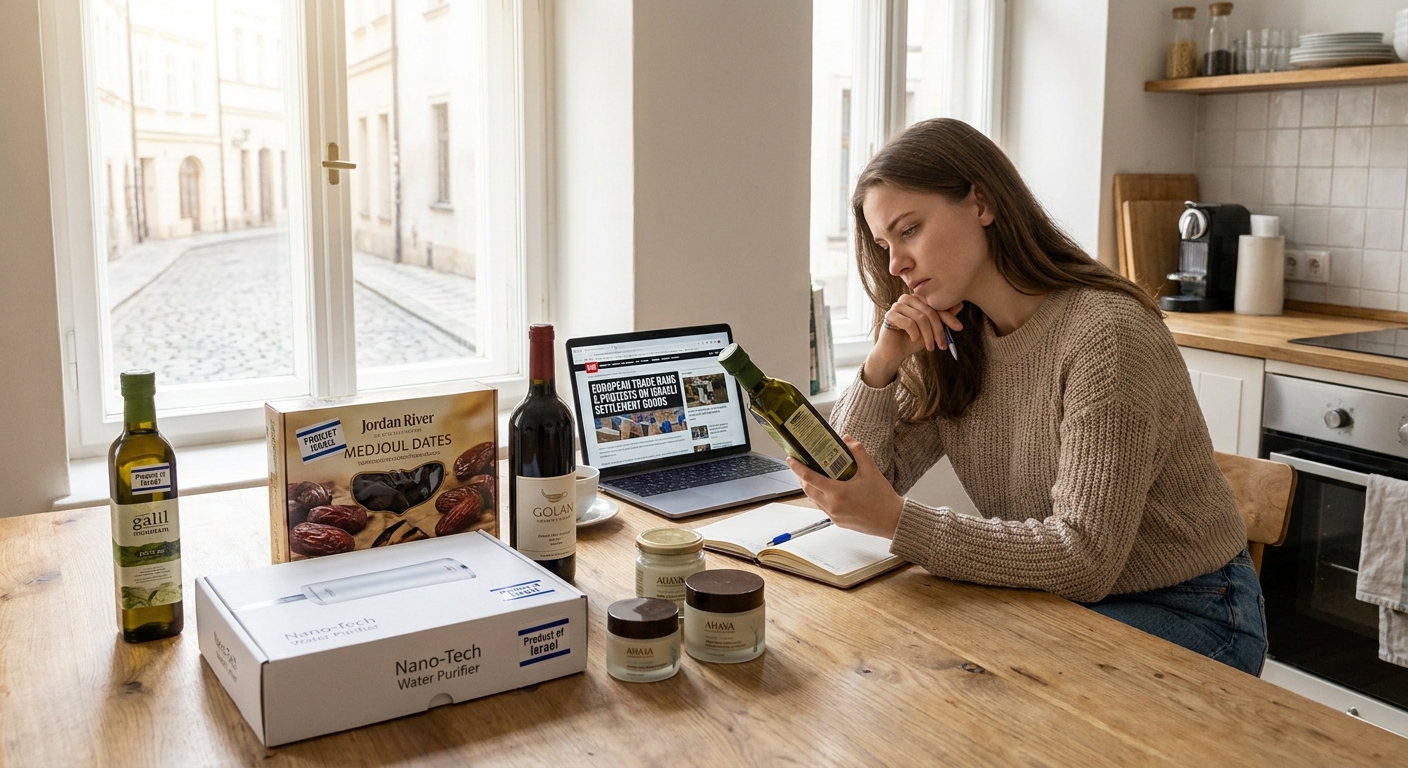
You are not imagining the confusion. One day you are ordering Israeli olive oil, Medjool dates or Dead Sea cream like usual. The next day, your feed is full of boycott calls, customs disputes and arguments over whether a product is “Made in Israel” or from an Israeli settlement. For many shoppers abroad, this stops being abstract politics fast. It turns into a very personal question. What exactly am I buying, and who am I supporting? The good news is that ethical shopping here does not have to mean guessing or panicking. It means slowing down, reading labels carefully, asking a few smart questions and buying from sellers who are clear about origin. If you want to keep supporting Israeli makers while staying true to your own values, there is a practical way to do it. You do not need to know every trade law. You just need a better shopping checklist.
⚡ In a Hurry? Key Takeaways
- Choosing Israeli products ethically starts with one thing. Check the stated place of production, not just the brand story.
- Look for transparent sellers who list the producer, region and import details, and contact them if anything is vague.
- Do not rely on social media claims alone. Labels, importer records and retailer answers are usually more useful than viral posts.
Why this suddenly feels so messy
The words sound simple. “Made in Israel.” But in real life, that label can sit in the middle of trade rules, border disputes, retailer policies and activist campaigns. That is why shoppers in Europe and Canada are seeing more arguments over how products should be labeled, especially when goods come from areas beyond Israel’s widely recognized pre-1967 lines.
For the average buyer, this creates three problems at once. First, labels are not always consistent. Second, news coverage is often emotional and incomplete. Third, many people want to support Israeli businesses without accidentally buying something that conflicts with their beliefs.
That is exactly where a calm buying process helps.
What “Made in Israel” can mean on a product page
Sometimes it means exactly what you think
A winery in the Galilee. A cosmetics maker in Tel Aviv. A date grower in the Jordan Valley with clear export paperwork. In these cases, a seller may plainly say the item was made in Israel, packaged in Israel or exported from Israel.
Sometimes the location needs more detail
This is where controversy starts. Some products are made by Israeli companies operating in disputed areas or settlements. Depending on the country, retailer and customs rule, those goods may require different wording, face consumer protests or be treated differently for import purposes.
And sometimes the label is just too vague
“Product of the Holy Land.” “From the Dead Sea region.” “Packed for an Israeli brand.” Those phrases may be marketing shorthand, but they are not enough if you are trying to shop with care.
How to choose Israeli products ethically
If you are searching for how to choose Israeli products ethically, start with a simple rule. Separate your values from the noise, then match them with facts you can verify.
1. Read past the front label
The front of the package is often branding. The back label usually tells the real story. Check for the manufacturer name, production address, exporter and importer. On a website, look for the product specification tab or shipping details.
2. Look for the exact place of production
Country alone may not answer your question. If the issue that matters to you is whether a product was made inside internationally recognized Israeli borders or in a settlement area, you need the city, industrial zone or agricultural region.
3. Ask the seller directly
This is the most underrated step. A trustworthy retailer should be able to tell you where the item was produced, not just where it shipped from. Ask in plain language: “Can you confirm the production site for this item?” If the answer is fuzzy, move on.
4. Watch for “packed in” versus “grown in” versus “made in”
These are not the same thing. Dates may be grown in one place and packed in another. Skincare ingredients may come from one region, while the final product is blended elsewhere. Wine is usually easier because vineyard and winery details are often part of the product identity.
5. Buy from businesses that are transparent on purpose
The best sellers do not make you play detective. They tell you who made the item, where it comes from and why that origin matters. That kind of openness is usually a good sign that they respect the customer and the producer.
What kinds of products are getting the most attention?
Wine
Israeli wine often carries strong regional branding, which can make origin easier to trace. Look for the winery address and vineyard region. If that information is missing online, ask before you buy.
Dates and olive oil
These are often at the center of labeling debates because farming areas can be politically sensitive. Here, exact farm or packing-house information matters more than broad branding terms.
Dead Sea skincare
This category can be especially confusing because “Dead Sea” describes a region, not a clear legal label. A product may use Dead Sea minerals, be manufactured elsewhere, or be sold under an Israeli brand with a separate production site. Check the company address and the stated manufacturing location.
How not to get misled
Do not trust a screenshot over a label
Social media is full of recycled claims, old customs notices and activist lists that may be incomplete or outdated. They can be useful as a prompt to check further, but they should not be your final source.
Do not assume every Israeli brand is the same
One of the biggest mistakes people make is treating all Israeli goods as one block. They are not. Big exporters, family farms, boutique wineries and skincare labs all have different ownership, locations and supply chains.
Do not confuse political opinion with product facts
You can have strong feelings about the wider conflict and still shop carefully. Ethical buying works best when it is based on clear information, not sweeping assumptions.
A practical buyer checklist
Before you click buy, run through this short list:
- Is the product origin listed clearly?
- Can you identify the producer or manufacturer?
- Does the seller distinguish between made, grown, sourced and packed?
- If location matters to your values, is the exact region stated?
- Did customer support answer direct questions clearly?
- Are you buying from a retailer that seems consistent and honest across its catalog?
If you can answer yes to most of those, you are in much safer territory.
What ethical shopping can look like in real life
For one shopper, ethical means supporting Israeli small businesses no matter what, as long as the seller is honest. For another, it means buying only from producers located within specific borders. For someone else, it may mean avoiding products with unclear sourcing altogether.
All three approaches are valid if they are informed. The key is to choose consciously, not accidentally.
That matters for decent producers too. Many Israeli makers, especially smaller ones, are being pulled into a global argument they did not create. Clear, careful shopping helps reward the businesses that are open about who they are and where they work.
At a Glance: Comparison
| Feature/Aspect | Details | Verdict |
|---|---|---|
| Clear origin labeling | Lists manufacturer, address, and specific production region | Best choice for ethical buying |
| Vague regional marketing | Uses terms like “Holy Land” or “Dead Sea” without exact production details | Proceed carefully, ask questions first |
| Seller transparency | Customer support provides direct answers about sourcing and manufacturing | Strong sign the retailer is trustworthy |
Conclusion
The headlines are loud, but your shopping decision does not have to be. If you have been feeling worn out by nonstop coverage of trade fights, protests and calls to ban certain Israeli goods, you are not alone. The smartest response is not to tune out. It is to get specific. Read the label. Ask the seller. Choose businesses that are open about origin and production. That way, you can stay loyal to the Holy Land in a way that matches your conscience, avoid getting pushed around by misinformation and support trustworthy Israeli makers with confidence. Ethical buying here is less about taking a side in every argument and more about making sure your money goes where you believe it should.