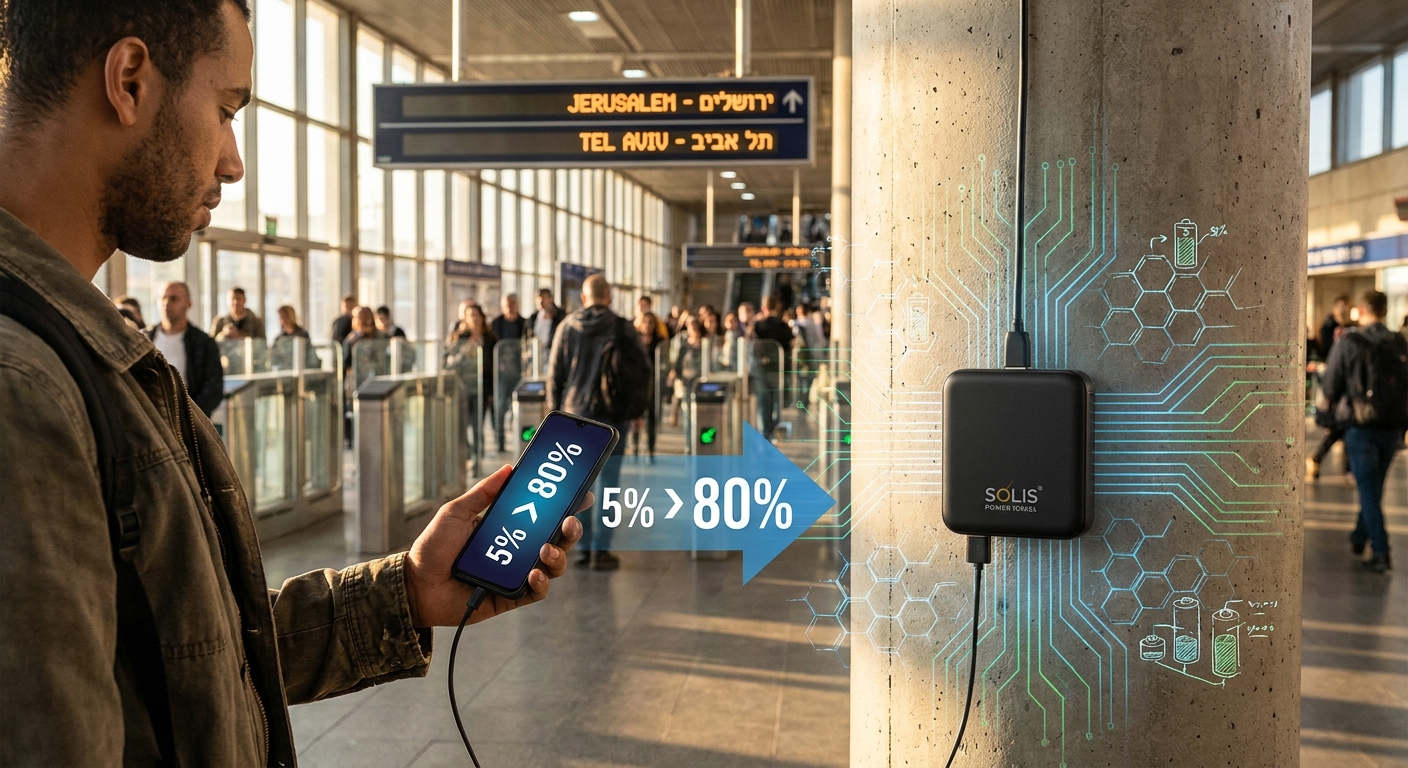
You know the routine. Your phone drops to 14 percent right when you are leaving the house, boarding a train, or trying to pull up a payment app at the worst possible moment. Then comes the awkward wall-hugging. You stand near an outlet, watching the battery creep upward like it is doing you a favor. That is why the latest Israeli fast charging battery 5 minute phone charge news matters. This is not just another flashy lab claim about some future battery that may never show up. Israeli battery companies and research teams have spent years working on ultra-fast charging and safer battery materials, and now the story is finally getting more real, more specific, and a lot closer to products ordinary people might actually buy. The short version is simple. A true full charge in five minutes is still not what most phones will get tomorrow morning, but dramatically faster top-ups are now moving from science project to shopping decision.
⚡ In a Hurry? Key Takeaways
- Israeli battery tech has helped push ultra-fast charging from lab demos toward real products, but most people should expect very fast partial charges first, not magic full charges in five minutes.
- If you are buying soon, look for phones and power banks that support modern USB-C Power Delivery and clear thermal safety claims, not just huge wattage numbers on the box.
- Fast charging is only worth it when the battery chemistry, charger, and cable all work together safely. Cheap mystery accessories are where problems start.
What is actually new here?
For years, battery stories have sounded the same. A startup says it cracked ultra-fast charging. A research lab says it solved battery degradation. Then nothing shows up in your pocket.
This time, the difference is that the Israeli side of the battery world is no longer talking only in theory. Companies tied to Israel’s battery ecosystem, including StoreDot, have spent a long time working on extreme fast charging cells, silicon-dominant materials, and ways to charge quickly without cooking the battery. That work is now showing up in supply-chain deals, manufacturer partnerships, testing milestones, and clearer roadmaps.
That does not mean your next iPhone or Galaxy will leap from 1 percent to 100 percent in the time it takes to order coffee. It does mean the gap between “my phone is dying” and “I can get through the next few hours” is getting much smaller.
Why “5-minute phone battery” needs a translation
When you see a headline about a 5-minute phone charge, read the fine print in your head.
Usually, it means one of three things
First, it may mean a lab cell, not a finished phone battery. A lab cell is important, but it is not yet a shipping product.
Second, it may mean enough charge for meaningful daily use, not a complete 0 to 100 refill. For a lot of people, that is still a huge win. If five minutes gets you from panic mode to several more hours, that changes your day.
Third, it may depend on ideal conditions. That includes battery temperature, charger quality, cable quality, and software controls inside the phone.
So yes, the phrase is exciting. But the useful consumer question is better phrased like this. “Can this battery give me a real, safe, fast top-up when I need it?” That answer is getting closer to yes.
The Israeli names to know
The best-known name in this space is StoreDot. It has been one of the most visible Israeli companies pushing extreme fast charging batteries, especially around silicon-rich battery materials that aim to charge much faster than today’s standard lithium-ion packs while keeping decent battery life.
StoreDot has spent years talking about “XFC,” short for extreme fast charging. Its goal has been to make charging times feel less like waiting for a tank to fill and more like a quick pit stop. The company has also worked with major global partners, which matters more than flashy demos. Partnerships are how battery ideas get out of press releases and into products.
There is also a broader Israeli energy-tech and materials scene helping this kind of progress along. Some firms focus directly on batteries. Others work on power management, thermal control, or advanced materials that make fast charging safer and more practical.
So when will regular people actually see this?
This is the question that matters. Not “Is the science impressive?” but “Should I wait to buy?”
Near term
Over the next product cycles, the most realistic change is faster partial charging in premium phones, power banks, wearables, scooters, and other portable gear. Think stronger “I forgot to charge and now I am saved” performance.
Medium term
As battery materials get cheaper and more stable, these gains should move into more mainstream devices. That usually happens in layers. First the expensive models. Then the better mid-range products. Then everyone copies it.
What probably will not happen overnight
A true universal five-minute full charge for every phone, at low cost, with no trade-offs, is still not here. Battery chemistry is stubborn. Heat is stubborn. Physics is very stubborn.
What this changes for everyday life
This is why ordinary people should care. Better fast charging does not just save time. It changes habits.
You stop planning your day around power outlets.
You carry fewer backup gadgets.
You worry less before a flight, a long commute, or a day of photos, maps, messaging, and mobile payments.
And if you pair faster charging with better home backup tools, your whole power setup gets calmer. If that idea speaks to you, our piece on From Negev Solar Fields to Your Power Strip: The New Israeli ‘Smart Solar Backup’ Keeping Small Homes Online When the Grid Blinks looks at another practical Israeli energy upgrade that helps when the grid gets unreliable.
How to spot hype versus the real thing
Battery marketing is full of giant promises. Here is the simple filter I would use.
Good signs
Look for named partnerships with known electronics brands, battery makers, or automakers. That shows somebody serious has done homework.
Look for language about cycle life. In plain English, that means how well the battery holds up after lots of charging. A battery that charges in five minutes but ages terribly is not a breakthrough for normal people.
Look for thermal management details. Heat is the enemy of battery life and safety.
Look for standard-friendly charging support, especially USB-C PD or other clearly explained charging systems.
Red flags
Be cautious if all you see is one dramatic demo video, vague launch dates, or claims with no mention of battery lifespan, safety testing, or manufacturing partners.
Also be careful with accessories that promise miracle speeds. The battery, cable, charging brick, and phone all have to agree with each other. One weak link slows everything down.
Should you wait before buying a new phone?
Usually, no.
If your current phone is old, cracked, unreliable, or already limping through the day, buy based on what is actually available now. Chasing future battery headlines can keep you waiting forever.
Wait only if these apply
You upgrade often anyway, and you are already close to the next major phone release cycle.
You care a lot about fast charging and are shopping premium devices where these advances tend to appear first.
You are also replacing your charger and cables, so you can build a full setup around the new standard.
Buy now if these apply
Your phone battery is already causing daily stress.
You need dependable charging for travel or work.
You found a current phone with strong battery life and genuinely fast charging from a reputable brand.
Simple buying signals to watch for
If you want to prepare for the Israeli fast charging battery 5 minute phone charge wave without getting fooled, keep your eye on these signals:
1. Clear charge-time claims
“0 to 50 percent in X minutes” is more useful than vague claims about “lightning speed.”
2. Battery health promises
If a brand talks about maintaining capacity after hundreds of cycles, that is a better sign than raw speed alone.
3. Real charger support in the box, or clearly listed
Some phones advertise fast charging but ship with slower charging gear. Check what is included and what is optional.
4. Known battery tech partners
If a device maker starts naming companies from the Israeli battery scene in official announcements or supply-chain reports, pay attention.
5. Safety certifications
Boring, yes. Important, absolutely.
What about cables and chargers?
This part gets overlooked all the time. People buy a fast phone, then use a random old cable from the junk drawer and wonder why charging feels ordinary.
If ultra-fast charging matters to you, treat the charger and cable as part of the battery system.
Use the right cable
A quality USB-C cable rated for the power your device needs makes a real difference. Cheap cables can slow charging or run hotter than they should.
Use a reputable charger
Stick with the phone maker’s charger or a trusted third-party brand with proper safety protections.
Avoid bargain-bin “super fast” claims
If the price looks absurdly low and the brand name feels invented yesterday, skip it.
At a Glance: Comparison
| Feature/Aspect | Details | Verdict |
|---|---|---|
| “5-minute charge” claim | Often refers to lab results or very fast partial charging, not always a full real-world phone refill | Promising, but read carefully |
| Israeli battery companies | Firms like StoreDot are pushing extreme fast charging and working with larger industry partners | Worth watching closely |
| What buyers should do now | Choose phones with proven fast charging, good battery health, and safe chargers and cables | Best practical move today |
Conclusion
The reason this story matters is simple. Battery news usually gets buried in investor filings, engineering jargon, and bold claims that feel far away from everyday life. But this is one of the most practical Israeli innovations on the horizon. It affects how you travel, how long your devices stay useful, and whether one good cable can rescue a messy day. The smart move right now is not to fall for every “five-minute battery” headline, but not to shrug it off either. Watch the real product names. Watch the partnerships. Watch the charging standards and safety details. That is how you cut through the hype and spot which Made in Israel battery breakthroughs are truly getting close to your pocket, your bag, and your next upgrade.