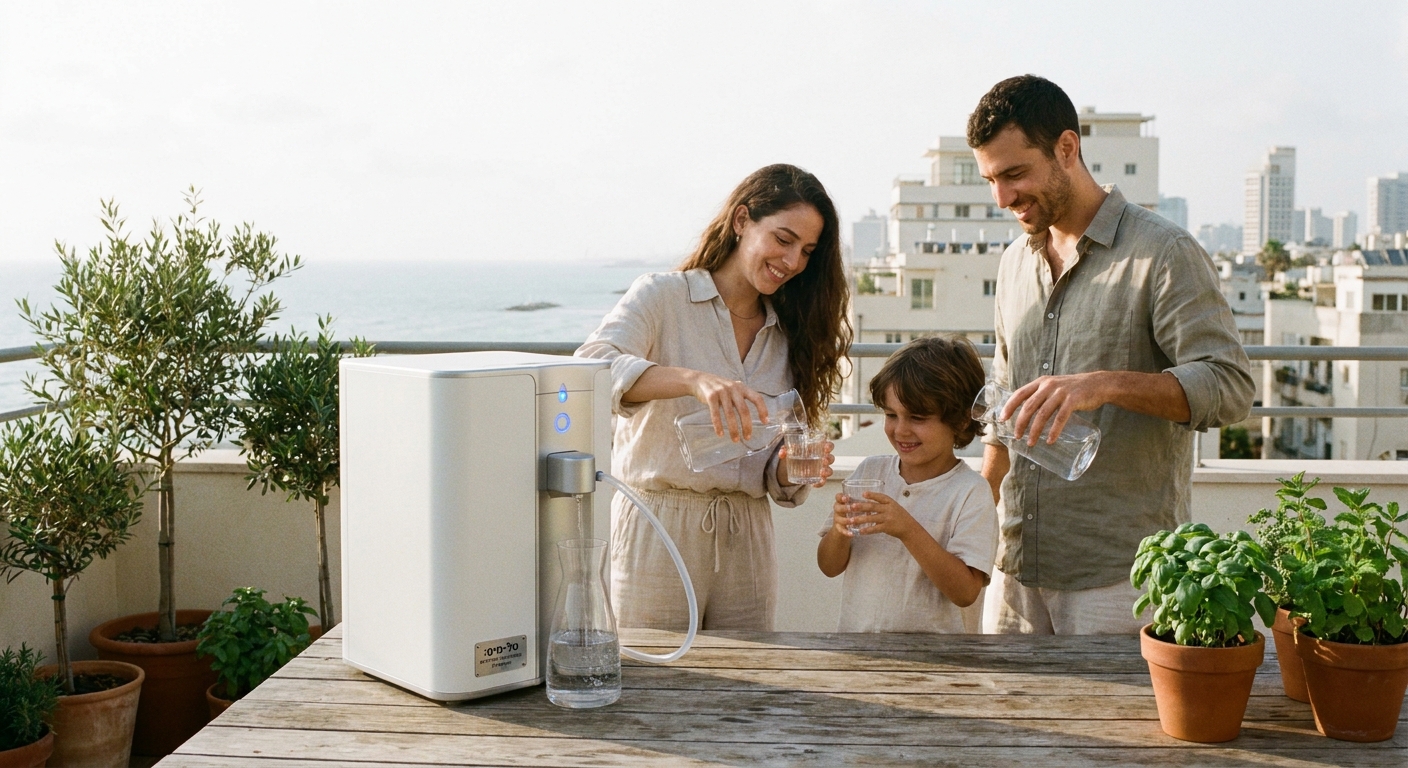
You can feel the frustration, can’t you? One week it’s a warning about old pipes. The next it’s a scare about PFAS, drought, flooding, or supply problems. Meanwhile, your “solutions” are not exactly elegant. Cases of bottled water clutter the garage. Pitcher filters take forever. Under-sink systems can be pricey and annoying to maintain. So when you hear about a machine that pulls drinking water straight from the air, it’s fair to be skeptical. It sounds a bit sci-fi. Still, the new Israeli atmospheric water generator for home use is getting real attention for a reason. These systems were shaped by desert conditions, heat, and the need for reliable water in places where every drop matters. Now, some of that same tech is moving into normal homes. Not bunkers. Not off-grid compounds. Just regular kitchens, balconies, and utility rooms where families want cleaner water and a little more peace of mind.
⚡ In a Hurry? Key Takeaways
- An Israeli atmospheric water generator for home use can be a practical backup or primary drinking-water source, but output depends heavily on your local humidity and temperature.
- Before buying, check three things first: daily liters produced in your climate, power use per liter, and whether the company has real global support for filters, parts, and service.
- These machines can offer very clean water when properly maintained, but they are not magic. In very dry or cold conditions, output can drop enough that a hybrid setup still makes the most sense.
What these machines actually do
At the simplest level, an atmospheric water maker pulls moisture from the air, condenses it into liquid water, then runs it through several purification and mineral stages so it tastes and drinks like proper bottled water.
Think of a dehumidifier, but smarter and built for drinking. Air comes in. Moisture gets separated out. The water is cleaned. Then it is stored in a protected tank or fed straight to a dispensing system.
That’s the basic idea. The difference between a cheap gimmick and a serious household unit comes down to how well it handles real-life conditions, how safe the water path is, and whether it can keep producing without burning through power.
Why Israeli water tech gets attention
Israel has a reputation for taking water seriously because it has had to. Hot weather, limited natural freshwater, security pressure, and the need for resilient infrastructure have pushed Israeli companies to build systems that work in tough conditions.
That matters for home buyers. You do not want a pretty machine that only performs in a showroom. You want one designed by people who assume heat, dust, grid stress, and supply uncertainty are part of normal life.
That is why an Israeli atmospheric water generator for home use stands out. The better brands are not selling a fantasy. They are selling engineered water independence, in a smaller form factor than the giant village-scale units many people first heard about.
How atmospheric water generators make drinking water
Step 1: Pull in air
A fan draws ambient air into the unit. Most systems use a pre-filter first to catch dust, pollen, and larger particles.
Step 2: Cool the air to condense moisture
The machine lowers the temperature of the incoming air until the water vapor turns into droplets. This is similar to the way water appears on a cold glass on a summer day.
Step 3: Purify the collected water
Collected water usually goes through multiple stages, often including sediment filtration, activated carbon, UV sterilization, and sometimes ultrafiltration or reverse osmosis style polishing, depending on the design.
Step 4: Add minerals back for taste
Pure condensed water can taste flat. Many better units re-mineralize the water with calcium or magnesium blends so it tastes more natural and is less aggressive to plumbing or storage components.
Step 5: Store and dispense safely
This part matters more than marketing brochures admit. Good systems keep tanks sealed, use food-safe materials, and circulate or sanitize stored water so it does not sit around going stale.
What kind of water output can you really expect?
This is where people either make a smart purchase or regret one.
Atmospheric water makers do not produce the same amount every day in every place. Their output rises when the air is warmer and more humid. It falls when the air is cooler or drier.
So if a brochure says “30 liters per day,” that may be based on favorable test conditions, not your back patio in February.
Best-case climates
If you live in a warm, humid area, coastal city, tropical climate, or a place with muggy summers, these units can perform very well. In those conditions, an apartment-friendly machine may produce enough for drinking and cooking for a small family.
Middle-ground climates
In moderate climates, output can still be useful, but you need realistic expectations. It may cover drinking water and coffee, but not all kitchen use.
Tough climates
If your air is very dry for much of the year, think desert interiors, high-altitude zones, or heated indoor winter air, production may drop sharply unless the unit is specifically engineered for low-humidity operation.
Israeli companies often get extra credit here because some are built with desert performance in mind. But even then, physics is still physics. Dry air contains less water to harvest.
A practical rule of thumb for families
If your goal is to replace every bit of household water use, these compact units are usually not the answer. That would require much larger production and a lot more electricity.
If your goal is to secure a clean, reliable source of drinking and cooking water, they make much more sense.
For many households, the sweet spot is 10 to 30 liters per day. That is enough to reduce bottled water dependence in a meaningful way without turning your utility room into a mechanical closet.
How much electricity do they use?
This is the second big reality check.
Atmospheric water generation is not free. The machine is cooling air, moving fans, sterilizing water, and sometimes heating or balancing internal conditions. That takes power.
Efficiency is often discussed as energy used per liter produced. The exact number varies by climate and machine design, but in general, warmer and more humid air is cheaper to harvest from than cold, dry air.
What that means for your bill
If you live somewhere humid and use the unit mainly for drinking water, the monthly electricity cost may feel reasonable, especially compared with premium bottled water delivery.
If you live somewhere dry and try to run the machine hard every day, the economics can get less attractive.
So do not ask only, “How many liters does it make?” Ask, “How many liters does it make in my weather, and what does each liter cost me in electricity?” That is the grown-up question.
Where these machines fit best in a normal home
Apartment balcony or enclosed patio
Some newer units are compact enough for a balcony, as long as the manufacturer allows that setup and the climate is suitable. Airflow and weather protection matter.
Utility room or laundry area
This is often the most practical location. It keeps noise and heat away from the kitchen while giving easy access for drainage, maintenance, and cleaning.
Kitchen-adjacent placement
Countertop and near-counter systems exist, but larger-capacity units are still usually better just outside the main kitchen zone. They are not all tiny, and some produce a low hum similar to a small appliance or portable air unit.
What to watch out for before you buy
1. Marketing claims based on ideal conditions
Always ask for output data at different temperatures and humidity levels, not just one impressive headline number.
2. Filter costs and replacement schedules
A machine is only as convenient as the replacement parts you can actually get. Check yearly maintenance cost before checkout, not after.
3. Tank hygiene and sanitation features
Look for UV protection, antimicrobial storage design, and clear cleaning instructions. Water safety is about the whole system, not just the moment of condensation.
4. Noise
Some units are whisper-quiet. Others are “quiet” in the way a mini fridge is quiet. That might be fine in a utility space, less fine beside your breakfast table.
5. Real shipping and support
Global shipping is nice. Global support is better. You want confirmed availability of filters, service contacts, and warranty handling in your country.
Which Israeli manufacturers are worth knowing about?
The best-known Israeli name in this space is Watergen. It has built a global reputation with larger atmospheric water systems for communities, commercial use, emergency supply, and institutional settings. It is one of the companies most associated with pulling potable water from air at serious scale.
For home shoppers, that matters because it shows the technology is mature, not experimental. What is changing now is form factor. More companies are trying to shrink and simplify atmospheric systems for residential use.
Another Israeli company often mentioned in this broader category is GENAQ’s not Israeli, so it does not belong on this list. That is a useful reminder to verify origin claims carefully. Quite a few atmospheric water brands market globally, but not all are Israeli, and not all have true residential models available right now.
At the moment, if you are specifically searching for an Israeli atmospheric water generator for home use, you should expect some overlap between companies known for commercial systems and newer residential distributors or partners adapting that tech for smaller settings. It is wise to contact the maker directly and ask very plain questions:
- Do you currently sell a true home unit, not just a commercial dispenser?
- What is the rated output at 30°C and 60% humidity, and at lower humidity too?
- Can it ship to my country?
- Who handles warranty work locally?
- How much are the yearly filters and sanitation parts?
Is this better than bottled water, tap filters, or reverse osmosis?
Compared with bottled water
Usually yes, if your goal is less plastic, less hauling, and more self-reliance. The upfront cost is higher, but the day-to-day convenience can be much better.
Compared with pitcher or faucet filters
These are much simpler and cheaper, but they still depend on whatever comes through your pipes. If your concern is source reliability as much as purification, atmospheric water has an edge.
Compared with under-sink reverse osmosis
RO is still one of the best mainstream ways to clean existing tap water. It is often cheaper to operate than atmospheric generation if your municipal supply is stable and reasonably safe to begin with. But RO cannot help much if supply interruptions, contamination scares, or pressure problems are the issue. Atmospheric water can.
Who should seriously consider one?
You are a strong candidate if you fit a few of these boxes:
- You do not fully trust your local tap water.
- You are tired of bottled water clutter and waste.
- You live in a climate with at least moderate humidity for much of the year.
- You want a resilient drinking-water backup that does not scream “survivalist.”
- You are willing to do routine maintenance the same way you would for an espresso machine, water cooler, or HVAC filter.
You may want to skip it, or at least pause, if you live in an extremely dry climate, are very sensitive to appliance noise, or simply want the cheapest clean-water solution possible. In that case, a solid under-sink filtration system may still be the more sensible buy.
How to shop without getting fooled
Here is the short checklist I would give a friend.
Ask for performance in your climate
Not “up to” numbers. Ask for realistic numbers.
Price the full first year
Include the unit, shipping, filters, sanitation items, and estimated electricity.
Check certifications
Look for materials safety, water quality testing, and electrical compliance for your market.
Read the manual before buying
Yes, really. If the manual is vague about cleaning, storage, or filter changes, that is a warning sign.
Prefer direct maker contact
Especially with a newer category like this, buying close to the manufacturer or a verified distributor is often smarter than buying from a random marketplace listing.
At a Glance: Comparison
| Feature/Aspect | Details | Verdict |
|---|---|---|
| Water output | Strong in warm, humid air. Noticeably lower in dry or cold conditions. Real-world production can differ a lot from brochure claims. | Great for drinking water if your climate cooperates. Verify local performance first. |
| Power use | Uses meaningful electricity because it must cool air and sanitize water. Efficiency improves in humid climates. | Reasonable for resilience and bottled-water replacement. Less ideal if lowest operating cost is your only goal. |
| Home practicality | Newer Israeli-derived systems are smaller and more realistic for balconies, utility rooms, and apartment use than older industrial units. | Promising category for normal households, but check support, filters, and noise before buying. |
Conclusion
If you have been looking for one home upgrade that makes life feel a little steadier, without turning your house into a prepper set, this is why atmospheric water is getting a second look. An Israeli atmospheric water generator for home use sits in a very interesting middle ground. It is practical, not theatrical. It comes from a place where water stress is real, engineering matters, and reliability is not just a marketing line. The tech is still not perfect for every climate or every budget. But it is no longer just a giant machine for remote villages or disaster zones. It is moving into the range of ordinary households that want safer drinking water, fewer plastic bottles, and a direct relationship with the source. In a world of war headlines, heatwaves, and supply worries, that kind of calm, useful resilience feels less like a luxury and more like common sense.