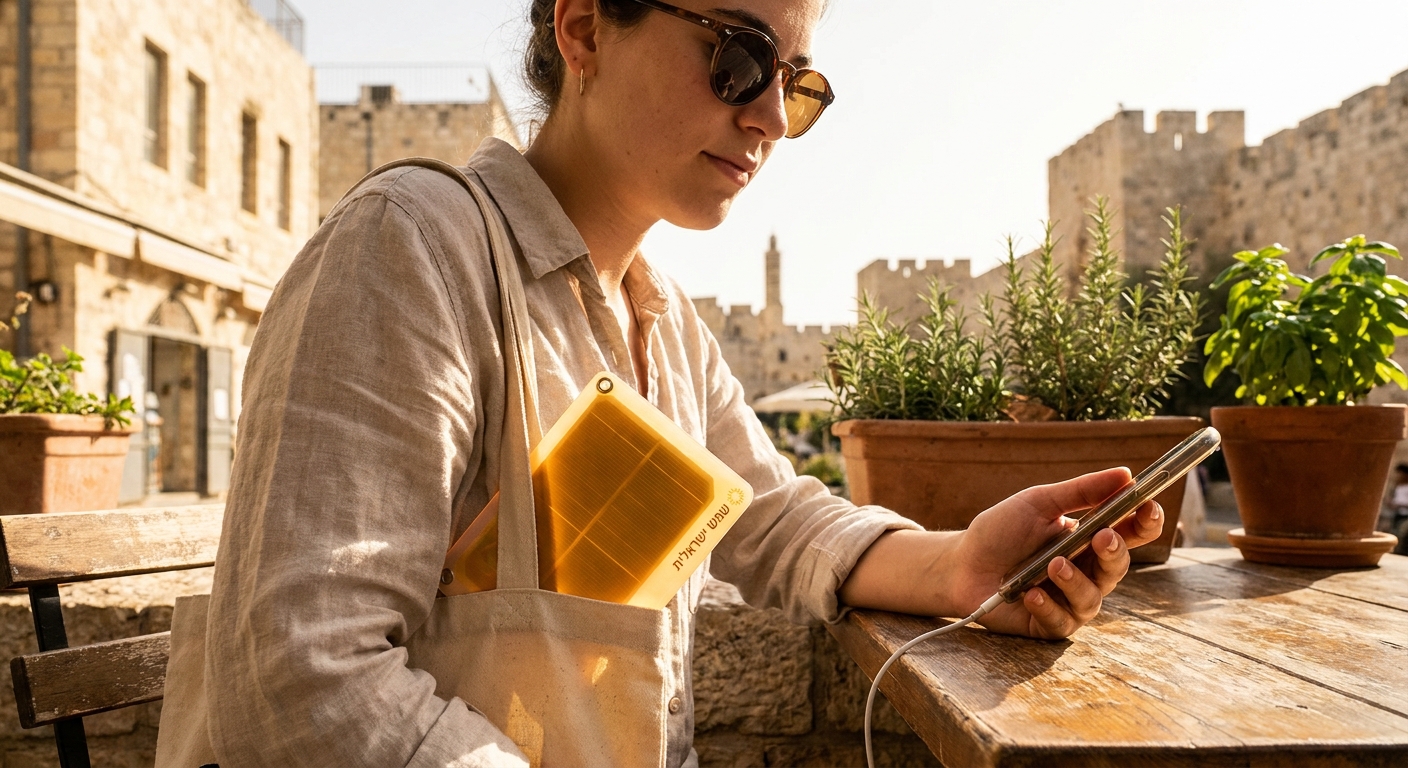
Your phone always seems to die at the worst possible moment. On the bus. In a long queue. During a power hiccup. Or right when you want to check updates, call family, or use a map. That is what makes most backup batteries so annoying. They are helpful, until you realize the power bank sitting in your bag is empty too. A good Israeli pocket solar phone charger aims to fix that problem in a simple way. It gives you a small, quiet backup power source that can sip energy from sunlight, and in some newer designs, even from strong indoor light. That does not mean magic. It means slower, steadier charging that can be a real comfort in daily life and in emergency prep. If you want something lighter than a brick-like battery pack, and easier to keep topped up, this little category of charger is worth a serious look.
⚡ In a Hurry? Key Takeaways
- A good Israeli pocket solar phone charger can provide slow but useful backup power when your wall charger or power bank is not available.
- Pick a model with a built-in battery, USB-C output, and realistic charging claims. Treat solar as backup, not your main daily charger.
- For commuting, travel, and emergency kits, the best value is peace of mind. It stays ready longer because light can keep topping it up.
Why this matters right now
When people talk about resilience, they often mean big things like grids, generators, or home batteries. But most of us meet the problem in a much smaller, more personal way. We just need our phone to stay alive.
That is why a pocket-size solar charger is getting attention. It borrows an idea from larger solar systems and shrinks it down into something you can actually carry every day. Not to run your house. Just to keep your lifeline in your pocket working when it counts.
The Israeli angle is part of the appeal here too. Israel has long had a strong culture of practical energy tech, especially anything built around efficiency, portability, and doing more with less space. That same thinking shows up in smaller consumer gadgets.
What an Israeli pocket solar phone charger actually does
Let us set expectations clearly. A pocket solar charger is not a miracle slab that fully charges a dead phone in ten minutes from a cloudy window.
What it does well is collect small amounts of power over time, store that energy in a built-in battery if the model includes one, and then pass it to your phone when needed. Think of it like a backup water bottle that refills itself slowly whenever it gets the chance.
There are usually two parts working together
First, the solar panel gathers energy from light. Second, a battery inside the device stores that energy so you can use it later, even at night or on the move.
The best models also include standard charging options. So you can top them up from a wall plug before a trip, then let the solar side maintain or extend that charge afterward.
Some newer models can use indoor light too
This is one of the more interesting changes. Traditional small solar panels are best in direct sun. Newer light-harvesting materials and improved efficiency can make some chargers more useful near windows, in offices, or under strong indoor lighting.
That does not mean indoor charging is fast. It usually is not. But for a backup device, even a slow trickle can make the difference between 0 percent and enough charge for a message, a location pin, or a short call.
Why people are choosing this over a standard power bank
Regular power banks still make sense. They are often faster, cheaper, and more predictable. The problem is simple. They only help if you remembered to charge them.
A solar-assisted unit has a different strength. It is easier to keep ready. Leave it near a window. Clip it to a bag. Set it on a balcony. Use it on a commute or while working outside. Over time, it keeps collecting.
That makes it especially appealing for three groups.
Commuters
If your battery is always dropping into the danger zone before you get home, this gives you another backup path.
Remote workers and travelers
If your day is spread across cafes, trains, buses, waiting rooms, and shared workspaces, every bit of extra battery life helps.
Emergency-minded households
For siren drills, short outages, or just general preparedness, it is one more low-stress tool to keep in a grab-and-go bag.
What to look for before you buy
This is where people get tripped up. Marketing around solar gadgets can be wildly optimistic. A smart buyer should ignore the flashy claims and focus on a few practical features.
1. A built-in battery
This matters a lot. A tiny panel feeding your phone directly is not very useful unless conditions are perfect. A built-in battery lets the charger collect power slowly and then deliver it when you need it.
2. USB-C support
USB-C is now the easiest, most future-proof choice for many phones and accessories. It also makes the charger easier to share across devices.
3. Realistic capacity numbers
If a very small device promises huge battery capacity and rapid solar charging, be skeptical. Physics still exists. Pocket size means trade-offs.
4. Rugged design
If this is going in a bag, glove box, or emergency kit, look for a model that feels sturdy, with decent weather resistance and solid port covers.
5. Clear charge indicators
You want simple lights or a small display that tells you how much stored power is left. Guessing is not fun when you actually need it.
How fast is it, really?
This is the question everyone asks, and the honest answer is, slower than a wall charger. Usually much slower.
That sounds disappointing until you look at the real job. This type of device is not trying to replace your 30-minute fast charger at home. It is trying to give you backup power when home is not part of the equation.
In direct sun, a good compact charger may add meaningful emergency power over a few hours. In bright indoor conditions, the gain will likely be more modest. Enough to extend life. Enough to keep a backup battery from sitting dead for weeks. Enough to help.
Best use cases for this kind of charger
An Israeli pocket solar phone charger makes the most sense when you use it as a quiet safety net.
In your everyday bag
Keep it with your cable and forget about it until you need it. That is the whole point.
In a car emergency kit
Even if you have USB ports in the car, redundancy matters. Cables fail. Cars are not always running. Backup is backup.
For students and city commuters
If you are out all day and power outlets are always occupied, this is a simple extra layer.
For families
Parents know the drill. One dead phone can turn a simple pickup or change of plans into a mess. A tiny light-fed charger is one of those tools you barely notice until the day you are glad it is there.
What not to expect
It is just as important to know the limits.
Do not expect full-speed charging like a wall brick.
Do not expect a tiny panel to fully refill a large phone every day from weak light alone.
Do not expect every cheap marketplace listing to be honest about performance.
If you buy it for the right reason, as backup power that can renew itself, you are far more likely to be happy with it.
Why the Israeli connection stands out
Israeli energy tech has a reputation for practical problem-solving. That matters here. The best gadgets in this space are not trying to impress you with gimmicks. They are trying to solve a very real everyday problem with as little hassle as possible.
That means compact size, efficient charging, and enough toughness for real life. In a product category crowded with generic lookalikes, a vetted Israeli pocket solar phone charger can feel more trustworthy because the design goal is function first.
At a Glance: Comparison
| Feature/Aspect | Details | Verdict |
|---|---|---|
| Charging speed | Wall charging is fastest. Solar charging is slower and best for topping up or emergency use. | Good as backup, not your main charger |
| Portability | Pocket or bag-friendly size, lighter than many large power banks, easy to carry daily. | Strong advantage for commuting and travel |
| Readiness | Can slowly recharge itself from sunlight, and sometimes useful indoor light, instead of sitting empty for weeks. | Excellent for emergency kits and peace of mind |
Conclusion
If you are tired of carrying yet another dead gadget that was supposed to save the day, this is a refreshingly practical idea. A reliable Israeli pocket solar phone charger will not replace your normal charger, and it will not bend the laws of physics. But it can give you something just as useful. A little extra time, a little extra connection, and a lot less worry. In a week where energy stability and resilience are top of mind, a reliable way to turn sunlight and even indoor light into quiet backup power is more than a cool gadget, it is peace of mind. For travel, remote work, and emergency prep, a vetted Israeli option is a simple, affordable tool that can live in your bag today and quietly help when you need it most.