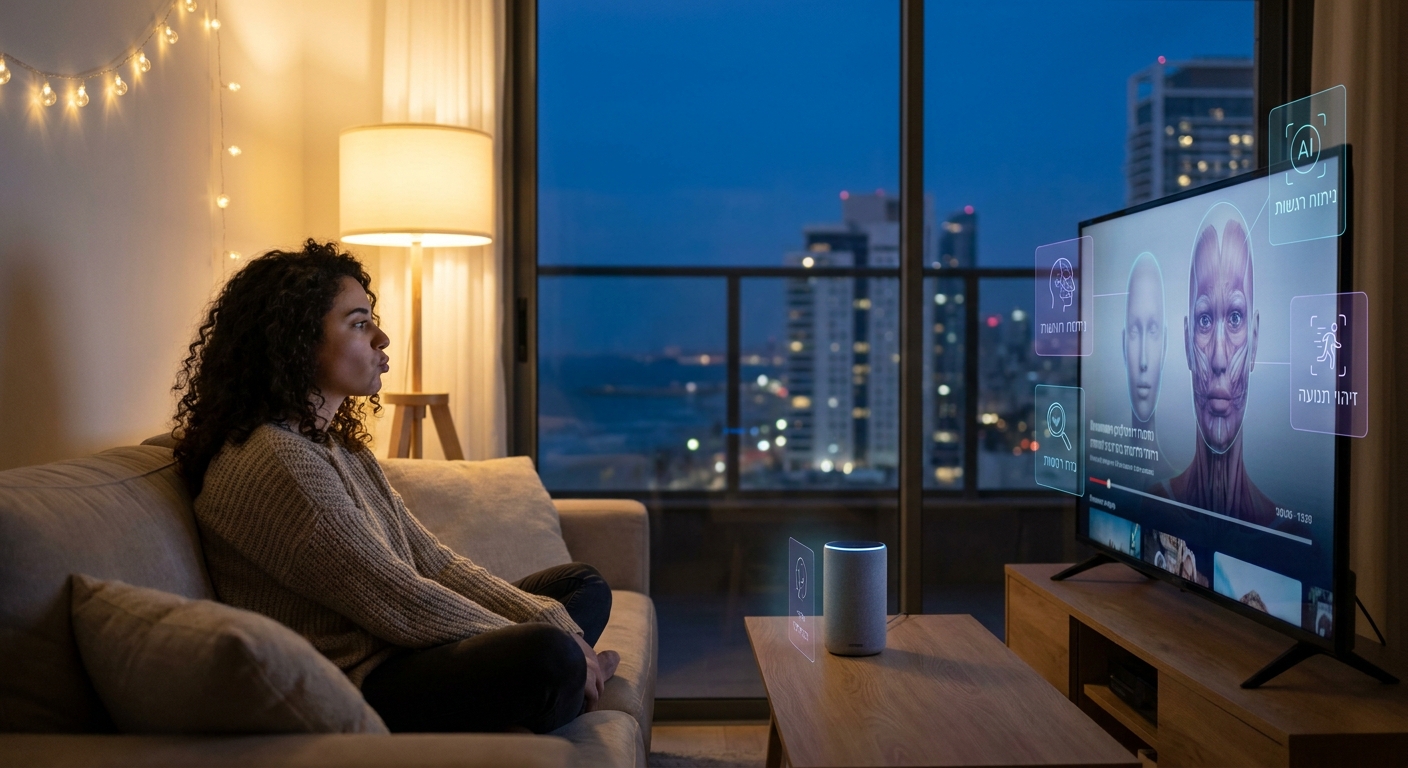
You should not have to bark at a smart speaker just to dim the lights. And you definitely should not feel like there is a microphone waiting for your next sentence every hour of the day. That is why a quieter kind of home tech is getting attention right now. A cluster of Israeli labs and startups has been working on what people loosely call “silent speech” systems. In plain English, that means software that reads tiny facial movements, jaw shifts, lip patterns, or cheek gestures and turns them into commands. Instead of saying “turn off the TV,” you might clench, purse, nod, or make a tiny trained expression. The appeal is obvious. More privacy. Less noise. Fewer late-night wake-ups. It is not magic, and it is not perfect yet, but for privacy-conscious shoppers, Israeli silent speech AI face control for smart home use could be one of the first genuinely useful alternatives to always-listening voice assistants.
⚡ In a Hurry? Key Takeaways
- Israeli “silent speech” tech uses facial movements instead of spoken commands, which can make smart homes feel less intrusive.
- If you are curious, start with one low-risk use like lights, TV pause, or muting a call, not full-home automation.
- This can reduce microphone dependence, but you still need to check camera privacy, data storage, and how the training works.
What this tech actually is
“Silent speech” sounds a bit sci-fi, but the basic idea is simple. A camera, wearable, or sensor watches for small facial signals. AI then maps those signals to a specific command.
Some systems focus on lip movement. Others watch muscle activity in the face and jaw. A few combine head pose, eye direction, and expression patterns. The goal is not to read your mind. It is to give you a quiet input method when talking out loud is annoying, awkward, or not possible.
That matters in a living room. If your partner is asleep on the sofa, if a baby is in the next room, or if your TV is too loud for your voice assistant to hear you, a subtle face-based command starts to make a lot of sense.
Why Israeli teams are showing up in this space
Israel has a long track record in computer vision, sensors, edge AI, and assistive tech. Those fields fit together neatly here. Face control for the smart home is really a mix of all four.
Tel Aviv and other Israeli tech hubs have produced companies that are good at reading human movement through ordinary cameras, improving low-power AI models, and building privacy-aware systems that do more processing on the device instead of sending everything to the cloud.
That last point is the key one for many readers. Plenty of people like smart home convenience. They just do not like the trade-off of putting another always-listening gadget in the house.
Why people are interested now
For years, voice control was sold as the easiest way to run a smart home. Then real life got in the way.
Voice assistants can be flaky
They mishear commands. They wake up by accident. They struggle with accents, background noise, and TV chatter. They also have a bad habit of becoming most annoying exactly when you need them to be quiet.
Privacy worries are not going away
Even when companies say they only listen after a wake word, many people still feel uneasy. That feeling is not irrational. Once a device has a microphone and a cloud connection, trust becomes part of the product.
Some shoppers want alternatives for personal or political reasons
Not everyone wants to buy deeper into the biggest platform ecosystems. Some want local processing. Some want less data collection. Some are trying to be more intentional about what kind of tech they bring into their homes.
How face control could work in your living room
The most likely early versions will be modest, and that is a good thing. Think simple commands, not a robot butler.
Useful early examples
A quick lip press could mute the TV. A cheek puff might pause a video. A raised eyebrow could turn on a lamp. A short nod could answer an incoming video call on your television.
Those sound small, but small is often what makes tech usable. Nobody needs twenty facial gestures to manage breakfast. You need three or four commands that work every time.
Where the camera sits matters
This could live in a smart TV, a set-top box, a soundbar, or a small hub aimed at the sofa. Some versions may use a phone or tablet camera instead. Others may show up in smart glasses or earbuds paired with other sensors.
The less setup required, the better the chance regular people will actually use it.
The big win is not convenience. It is control.
Convenience is nice. Control is better.
A face-based trigger system gives you a way to choose when you want AI help without leaving a microphone open as the main front door. That is the real shift. It changes the relationship between you and the device.
Instead of a speaker waiting for speech all day, you get a more deliberate action. You decide. The system responds. For many households, that feels healthier.
But let’s be honest about the trade-offs
This is not a perfect privacy shield. It just changes the risk profile.
A camera can still feel invasive
If a microphone makes you nervous, a camera may not feel much better unless the company clearly explains what is processed locally and what leaves the device.
Training can be fiddly
Most systems need to learn your face and gestures. That means setup time. It also means there may be false readings at first, especially in low light or when several people are in the room.
Not everyone wants to “perform” commands
Some people will love subtle gestures. Others will find them silly or tiring. Accessibility also cuts both ways. Face control could be excellent for some disabled users and less helpful for others depending on mobility, fatigue, or facial differences.
What to check before you buy anything like this
If products based on Israeli silent speech AI face control for smart home use start appearing on shelves or crowdfunding sites, do not just read the headline claim. Check the boring stuff.
1. On-device processing
Look for phrases like “processed locally” or “on-device inference.” That usually means the analysis happens in the gadget itself, not in a remote server farm.
2. Microphone options
See if the product lets you fully disable or physically disconnect the microphone. A privacy-friendly face control system should not force you to keep voice listening enabled.
3. Camera storage policy
Ask whether video is saved, for how long, and whether clips are used to improve the model. If the answer is vague, move on.
4. Command simplicity
The best systems will stick to a small set of reliable gestures. If the product promises fifty expressions on day one, be skeptical.
5. Guest mode and family mode
A good living room system should handle multiple people. It should also let guests use normal remotes without enrolling their faces.
Who should be most interested
This kind of tech is not for everyone yet. But a few groups should keep an eye on it.
Light sleepers and parents
If you are always trying not to wake someone up, silent commands are immediately appealing.
Privacy-conscious smart home users
If you want some AI help without installing a bunch of always-listening speakers, this could be your lane.
People frustrated with voice control
If your assistant constantly misunderstands you, a trained facial trigger may actually be more dependable for a handful of common tasks.
Accessibility users
Done well, this could open doors. Done badly, it could exclude people. So it is worth watching real-world testing, not just promo videos.
What is likely to happen next
Do not expect every home to ditch voice assistants this year. That is not how these transitions usually work.
What is more likely is a hybrid setup. Voice for open-ended requests. Face gestures for quick private commands. Remote control as backup. That three-way mix is probably where the market settles first.
And that is fine. New tech does not have to replace everything to be useful. It just has to solve one annoying problem better than the old method.
At a Glance: Comparison
| Feature/Aspect | Details | Verdict |
|---|---|---|
| Privacy vs voice assistants | Can reduce reliance on always-listening microphones, especially if processing stays on-device. | Promising, but only if camera and data policies are clear. |
| Ease of use | Best for a small set of repeated commands like mute, pause, lights, or answer call. | Good as a secondary control method, not a full replacement yet. |
| Real-world value | Most useful in shared homes, late at night, or for users who dislike speaking to devices. | Worth watching closely, especially from Israeli startups focused on practical use. |
Conclusion
If you have been torn between wanting a smarter home and not wanting another device listening to every word, this is the kind of development worth paying attention to. Israeli startups and labs are helping push a more practical middle ground. You still get some of the benefits of AI, but with a quieter, more intentional way to trigger it. That helps the community right now because AI is suddenly everywhere, and many people are stuck between convenience, privacy worries, and bigger questions about what they are buying into. Face-based control will not solve everything. But it does offer a concrete way to test the next wave of smart home tech without signing up for a full surveillance-feeling setup. And maybe that is the most useful part of this story. It takes the conversation out of the abstract and brings it back to a very human question. How do I make my home easier to live in without feeling watched?