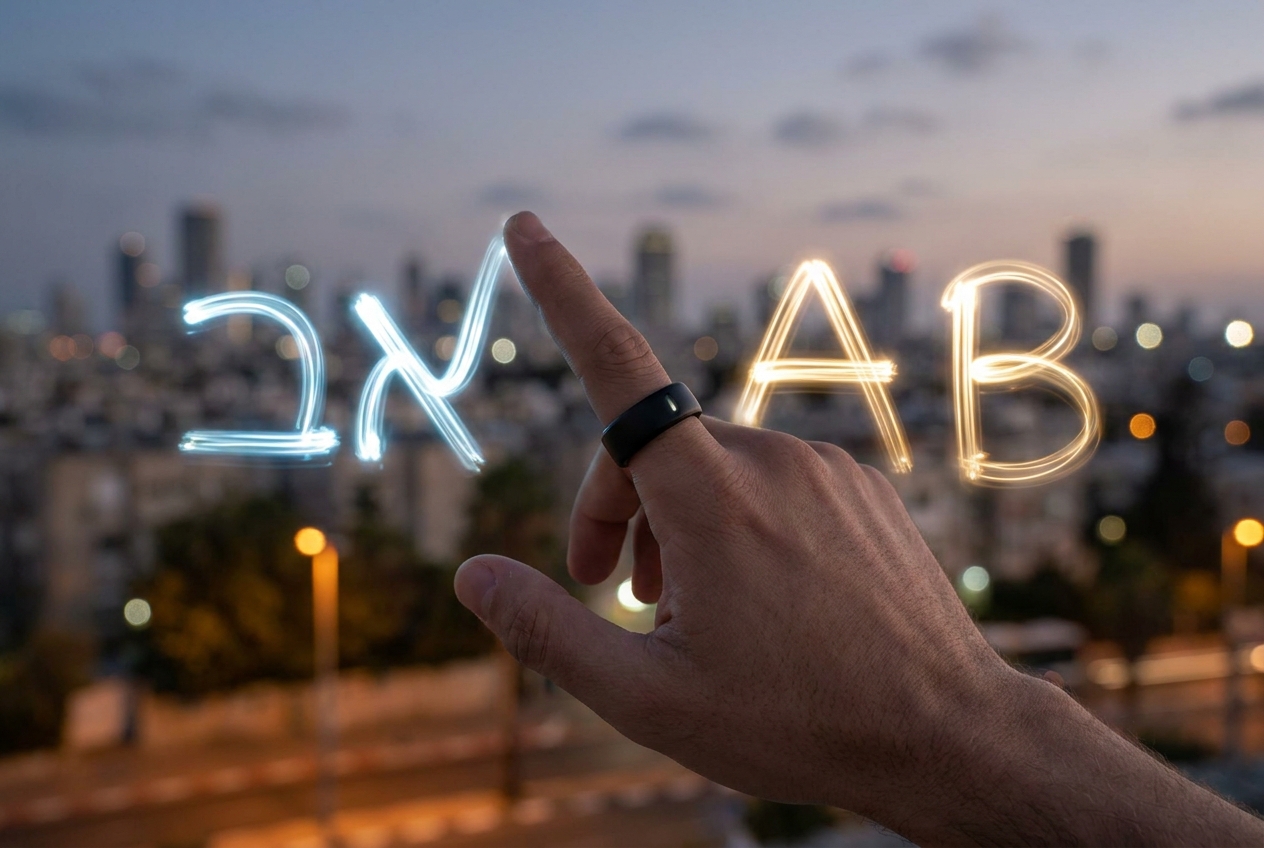
You know that little panic when a good idea shows up at the worst possible moment. Your hands are full, your phone is buried in a bag, and typing on glass feels slower than your brain. That is the gap this Israeli smart ring that turns handwriting into text is trying to fix. Instead of poking at a screen or sending yet another awkward voice note in public, you simply write in the air with your finger and the ring is meant to convert those movements into text. It sounds a bit like science fiction, but the real appeal is very ordinary. It is about catching thoughts before they disappear. This young Tel Aviv project is still early. It is prototyping and fundraising, not mass market yet. But that is exactly why it matters now. It gives shoppers a first look at a product that could make wearables actually useful, not just one more gadget that counts steps and buzzes your wrist.
⚡ In a Hurry? Key Takeaways
- This Israeli smart ring that turns handwriting into text aims to let you write in the air and send notes to a phone or device.
- If you are curious, watch for proof of accuracy, battery life, app support, and real-world demos before you buy.
- Because the product is still young, the value today is learning to spot real innovation early, not rushing into hype.
What problem is this ring actually solving?
Most of us do not have a note-taking problem. We have a timing problem.
Ideas come while walking, shopping, waiting in line, or trying not to wake a sleeping child. Phones are powerful, but they are not always quick. Unlock. Open app. Tap tiny keys. Hope autocorrect does not turn your reminder into nonsense.
Voice notes help sometimes, but not everywhere. They are awkward on a bus, rude in a meeting, and useless in a noisy supermarket.
So the pitch here is refreshingly simple. Wear a ring. Move your finger as if you are writing. Let sensors track those movements and turn them into digital text.
If that sounds familiar, our earlier look at From Tel Aviv Finger Labs to Your Daily Notes: The New Israeli Smart Ring That Turns Air Writing Into Text touched on the same everyday frustration. The reason it resonates is that it does not try to invent a new human habit. It uses an old one. Writing.
How does an Israeli smart ring that turns handwriting into text work?
At the basic level, the ring uses motion tracking. Think tiny sensors that can detect how your finger moves through space. Software then tries to match those movements to letters, words, or commands.
That is the clever bit. Hardware sees motion. Software decides whether that motion meant an A, a shopping list, or a quick message.
Why a ring instead of a watch?
A ring sits right on the finger doing the writing. That gives it a better chance of capturing small, natural movements. A watch can track your arm. A ring can get closer to the action.
Why handwriting still matters
People may type all day, but handwriting is still deeply natural. We remember shapes. We sketch ideas. We jot lists. A product like this is betting that air writing can feel more intuitive than tapping a tiny screen.
Why this matters beyond the gadget itself
This story is not only about one ring. It is about a category that is about to get crowded.
Once bigger global brands smell interest, the market will flood with lookalikes. Some will be smart. Some will be all marketing. That is why it helps to see a young Israeli team at the early stage, when the main question is still, “Does this solve a real problem?” and not just, “Can we package it nicely?”
That early view is useful for shoppers. It is also useful for the Israeli tech community. Instead of waiting until a foreign giant puts out a polished version of the same idea, readers get to see where fresh thinking starts.
What should shoppers pay attention to before getting excited?
This is where it helps to stay grounded. A prototype can be brilliant and still not be ready for daily life.
1. Accuracy
The biggest test is simple. Does the software correctly read what you meant to write?
Even a small error rate can get annoying fast. If “milk, eggs, bread” becomes gibberish, the magic disappears.
2. Learning curve
Will users need to write in a very specific style, or does it work with normal hand motion? The best products adapt to people. The worst ones make people adapt to the product.
3. Battery life
A ring is tiny. Tiny devices have tiny space for batteries. If it needs charging too often, convenience takes a hit.
4. Comfort
Wearables only work if you forget you are wearing them. If the ring is bulky, heavy, or fussy, many people will stop using it.
5. Privacy
Unlike voice notes, air writing can be discreet. That is a big plus. But shoppers should still ask where text data goes, what the app stores, and how secure the system is.
6. Phone and app support
It needs to play nicely with the devices people already own. Smooth syncing matters as much as the ring itself.
Who is this for?
Not everyone. At least not yet.
The first people likely to care are note-takers, busy parents, commuters, founders, students, and anyone who constantly captures ideas on the move.
It may also appeal to people who are tired of generic wearables. Plenty of rings and watches promise wellness scores, sleep tracking, and vague “insights.” Useful, maybe. But not exactly life-changing for everyone.
This idea feels more practical. It is trying to help you do something, not just measure something.
Why this is a very Israeli kind of product
Israel has a habit of building tools around irritation. Not grand theory. Real annoyance.
People lose ideas. Phones are clumsy in the moment. Voice input is not always socially comfortable. So a small team asks, can we fix that?
That mindset is part of why these early products deserve attention. They often start with a daily pain point, not a giant branding campaign.
For readers looking to support meaningful homegrown products, this is the kind of signal worth noticing. It is not a rebranded import with a Hebrew sticker on the box. It is a local attempt to make computing feel more human.
What could happen next?
Best case, this Israeli smart ring that turns handwriting into text becomes one of those rare gadgets that creates a new habit because it feels obvious once you try it.
Middle case, the team proves the concept well enough that a larger company copies the idea or partners with them.
Worst case, it turns out to be one of those products that looks amazing in demos and frustrating in real life.
All three are possible. That is the honest truth with young hardware.
Still, even at this stage, watching the category now gives buyers a head start. You begin to learn the right questions before the market gets noisy.
At a Glance: Comparison
| Feature/Aspect | Details | Verdict |
|---|---|---|
| Core idea | Lets users write in the air and aims to convert those movements into digital text. | Genuinely interesting, especially for quick notes and reminders. |
| Everyday usefulness | Could be more practical than voice notes or screen typing when your hands are busy or you are in public. | Promising, but only if accuracy and comfort are strong. |
| Buying readiness | The Tel Aviv team is still prototyping and fundraising, so this is early-stage hardware. | Worth watching closely, not something to judge like a finished retail product yet. |
Conclusion
There is something refreshing about a wearable that tries to save a thought instead of just counting a step. Spotlighting this brand new Israeli smart ring today helps the community in three clear ways. First, it gives readers and buyers a plain-English look at a new product category before bigger brands flood it with hype. Second, it shines a light on a young Tel Aviv hardware team that is still building, testing, and raising support, which helps IsraSale act as a bridge between early Israeli makers and everyday shoppers. Third, at a time when many people want Israeli products that feel useful and meaningful, this ring offers a concrete example of where that future might go. You do not need to treat it as finished to see why it matters. Sometimes the smartest shopping move is learning early, asking better questions, and backing the ideas that feel real before everyone else catches on.