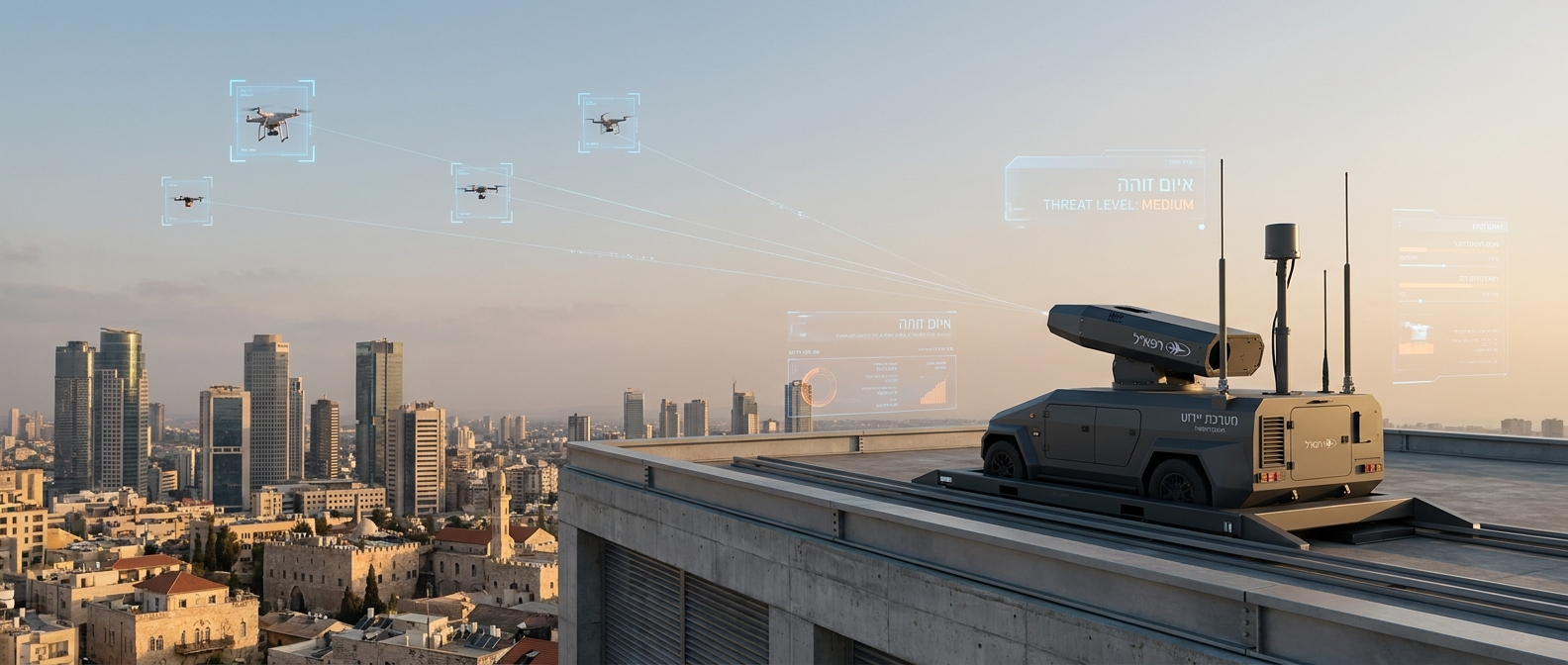
A cheap drone can turn a normal security plan into Swiss cheese. That is the part many site managers, factory owners, event planners and campus teams are now learning the hard way. You can have gates, guards, cameras and motion lights. None of that helps much when a small quadcopter pops up over a fence, hovers near a warehouse roof, or flies across a stadium parking lot at dusk. The frustrating part is that most advice on this topic still sounds like it was written for generals, not people trying to protect a business on a budget. The good news is that Israeli anti drone technology 2026 is starting to look a lot more practical. These are not just giant military systems anymore. A new wave of Israeli drone shields is being shaped for everyday security use, with tools that can detect, track and sometimes stop suspicious drones in ways that make sense for commercial sites, public venues and local agencies.
⚡ In a Hurry? Key Takeaways
- Israeli anti drone technology 2026 is moving from military-only systems to buyable commercial solutions for factories, campuses, utilities and events.
- Start with detection first. The best first purchase is usually a system that spots and identifies drones before you spend money on active countermeasures.
- Always check local law before buying any jammer or takedown tool. In many places, detection is easier to approve than disruption.
Why everybody is suddenly worried about small drones
It is not hard to see why this market is heating up. Consumer drones got cheaper. Flight range improved. Cameras got better. Autopilot features got simpler. That means almost anyone can send a drone over private property with very little skill.
Sometimes it is just a nuisance. Sometimes it is far more serious. A drone can snoop on outdoor storage, map a facility layout, interrupt a sports event, carry contraband into a prison, or create panic near an airport or power site. Even if no crime happens, the uncertainty alone creates a real problem for security teams.
Traditional security gear was built for people and vehicles on the ground. Drones do not follow those rules. They are small, fast, and hard to spot with the naked eye. They can come from odd angles. They can disappear just as quickly.
What makes Israeli anti-drone systems stand out
Israel has spent years building drone defense under real pressure, which is why so much of the technology coming out now feels field-tested rather than theoretical. That matters. Buyers do not need another flashy trade show promise. They need systems that can work in wind, noise, clutter and crowded airspace.
The most useful Israeli systems tend to focus on a layered approach. In plain English, that means they do not rely on one sensor or one magic box. They mix tools like radio frequency detection, radar, electro-optical cameras, thermal imaging, signal analysis and software alerts.
That layered mix matters because drones are tricky. One drone may be easy to pick up by radio signal. Another may fly semi-autonomously and need radar or camera tracking instead. Good systems try to cover those gaps.
From warzone to workbench: what has changed for 2026
The big shift in Israeli anti drone technology 2026 is packaging. Older systems were often too large, too costly, too restricted, or too complex for non-military buyers. Newer offerings are being shaped into smaller fixed-site kits, mobile trailer systems, portable detection units and software dashboards that a commercial security team can actually run.
Think less “national air defense” and more “smart perimeter security for places with a drone problem.”
That includes:
- Factory and logistics sites that need rooftop and yard protection
- Solar fields and utility stations in remote areas
- Campuses and office parks with privacy and safety concerns
- Stadiums, concerts and VIP events
- Ports, rail hubs and municipal critical infrastructure
The parts of a modern drone shield, in normal language
1. Detection
This is the first job. The system figures out that a drone is in the area. It may do that by listening for radio signals, scanning the sky with radar, or using cameras and software to spot unusual movement.
If a vendor cannot clearly explain how detection works, that is a warning sign.
2. Identification
Not every flying object is a threat. A solid system helps classify what it sees. Is it likely a hobby drone, a bird, a helicopter, or just clutter? Better systems also try to identify the drone model, control link, direction of travel, and sometimes even the pilot location.
3. Tracking
Once spotted, the system needs to keep eyes on it. This sounds basic, but it is where many setups struggle. Tracking tells security whether the drone is passing by, circling, descending, or moving toward a sensitive area.
4. Response
This is the part everybody asks about first, but it should not be your first buying decision. Response may mean alerts to guards, automated camera zoom, airspace lockdown procedures, law enforcement notification, or active disruption where legal.
And that legal part is a big one. In many countries, jamming or forcing a drone down is tightly controlled. A commercial buyer may be allowed to detect and track, but not interfere with the aircraft directly.
What Israeli launches are aiming to solve now
The newest Israeli systems entering commercial catalogs are trying to solve three practical problems.
False alarms
If your system cries wolf all day, your team will stop trusting it. Newer software is getting better at sorting birds, noise and harmless air traffic from real drone activity.
Setup complexity
A lot of older defense tech needed specialists, large crews and deep training. Commercial buyers want cleaner dashboards, easier installation and clear alert workflows.
Cost per protected site
Not every location needs a full military stack. Vendors are starting to offer scaled versions, so a warehouse or private campus can buy a right-sized setup instead of a giant one.
How to shop for an anti-drone system without getting lost in jargon
If you are comparing products, do not start with brochures. Start with your site.
Ask these five questions first
1. What are you protecting?
A prison, a music festival, a pharmaceutical plant and a solar farm do not need the same system.
2. What kind of drone problem is most likely?
Are you worried about spying, smuggling, nuisance flights, sabotage, or just safety risk near crowds?
3. How much sky do you need to cover?
A compact site can use a very different layout from a wide industrial campus.
4. Do you need permanent coverage or temporary deployment?
Fixed installations and mobile event systems are different products.
5. What is legal where you are?
This can change the whole project. In some places, your best option is a detect-and-report setup, not a disable-and-drop system.
A simple buying checklist for non-engineers
- Ask which sensors are included, not just the brand name.
- Ask for actual detection range in cluttered real-world conditions, not only best-case range.
- Ask how the system handles low, slow and small drones.
- Ask how many false alerts customers typically see in a busy environment.
- Ask whether the software shows drone path history and likely pilot location.
- Ask how quickly alerts reach guards or operators.
- Ask what training your team needs after installation.
- Ask what happens if a drone uses autonomous flight instead of a normal control link.
- Ask what is legal to activate in your region.
- Ask for a live demo, ideally outdoors and not just on a screen.
Who should buy now, and who should wait
Buy now if
You run a site with repeated drone incidents, high-value assets, sensitive data exposure, public crowd risk, or regulatory pressure to improve airspace awareness. For these buyers, even a detection-only deployment can be worth it.
Wait, or start smaller, if
You have no real drone risk history and no sensitive perimeter. In that case, it may make more sense to begin with a site assessment and a pilot deployment rather than a full install.
The legal and safety reality nobody should skip
This market is exciting, but it is not a free-for-all. A lot of counter-drone tools touch aviation law, telecom rules, public safety rules and privacy issues. Jamming a drone signal sounds simple until it also affects nearby communications or creates a liability problem.
That is why many smart buyers start with awareness and evidence collection. A good detection platform can help you understand whether you truly have a drone problem, when it happens, and how serious it is. That data makes the next budget decision much easier.
What a sensible first deployment looks like
For most commercial sites, a smart first step is not “buy the strongest blocker.” It is this:
- Run a drone risk assessment.
- Map your sensitive zones.
- Install detection and tracking in the highest-risk area.
- Connect alerts to your existing security workflow.
- Review incident data for 60 to 90 days.
- Then decide if you need broader coverage or active response options.
That approach saves money and cuts down on panic buying.
Why this matters beyond security teams
This is also a business trend worth watching. Israeli anti drone technology 2026 is becoming easier for non-military buyers to understand and adopt. That opens the door for distributors, integrators, municipalities and facility operators who want to get ahead of demand instead of reacting after an incident.
It also means the conversation is finally becoming practical. Less chest-thumping. More real deployment planning.
At a Glance: Comparison
| Feature/Aspect | Details | Verdict |
|---|---|---|
| Detection-only systems | Use RF, radar, cameras, or a mix to spot and track drones without interfering with them. | Best starting point for most commercial buyers. |
| Active countermeasure systems | May jam, disrupt, spoof, or otherwise stop drone operations, depending on design and local law. | Useful, but only if legally approved and professionally managed. |
| Israeli 2026 commercial platforms | Smaller, more modular, field-tested systems aimed at factories, campuses, events and infrastructure sites. | The sweet spot for early adopters who want practical protection. |
Conclusion
Small drones are no longer a weird edge case. They are a real security gap, and more organizations are finally treating them that way. The encouraging part is that the market is maturing fast. Israeli anti drone technology 2026 is no longer just something you see at defense expos behind velvet ropes. It is becoming understandable, scalable and increasingly practical for everyday sites that need real protection. For the IsraSale community, that creates a genuine opportunity to get familiar with one of Israel’s hottest real-world tech categories before global demand really spikes. If you focus on detection first, ask plain-language buying questions, and match the system to your actual risk, you do not need to be an engineer to make a smart move here. That is exactly where IsraSale can shine, turning cutting-edge Israeli innovation into something useful, clear and actionable for regular decision-makers.