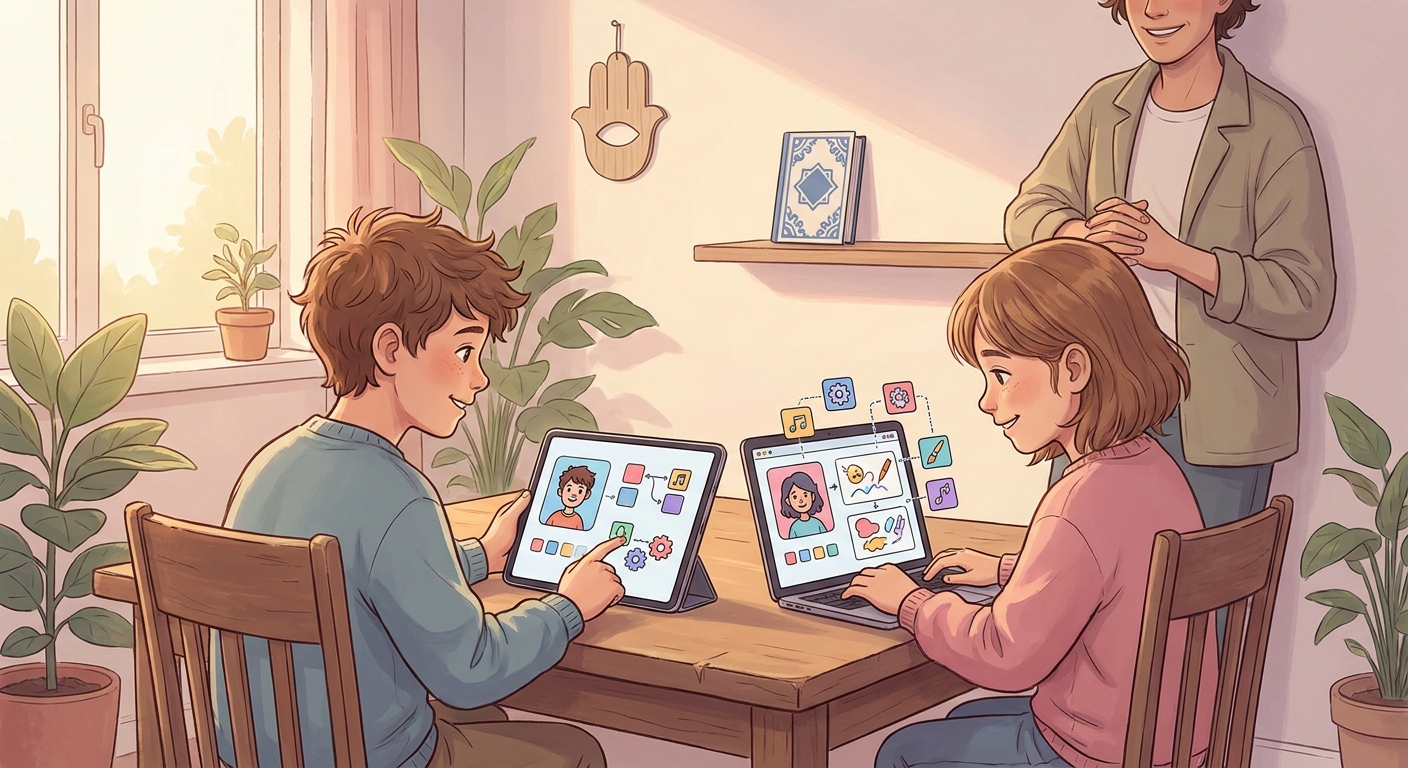
You want your kids to learn, create and stay curious online. That part is easy to agree on. The hard part is everything else. One app serves up junk ads. Another pushes weird videos. A chatbot that sounds helpful one minute can get inappropriate or manipulative the next. It leaves parents feeling stuck. You do not want to block the whole internet, but you also do not want to hand over the keys and hope for the best. That is exactly why the idea of an Israeli AI platform safe for kids stands out right now. Instead of asking children to use adult tools with a few safety settings bolted on, some Israeli developers are building AI spaces designed for children from the start. One example getting attention is Didi, a Ministry-approved platform created to let kids use AI for learning and creativity inside a more controlled, age-aware environment. For families and schools, that is a much more practical middle ground.
⚡ In a Hurry? Key Takeaways
- An Israeli AI platform safe for kids can give children room to create and learn without exposing them to the full chaos of open consumer AI tools.
- If you are a parent or teacher, start with a Ministry-approved child-focused platform like Didi instead of handing kids unrestricted chatbots.
- The big value is not just content filtering. It is a safer design that reduces toxic content, manipulative prompts and ad-driven distractions.
Why parents are so uneasy right now
Most families are not anti-tech. They are anti-risk.
Kids need digital skills. They need to know how AI works, how to ask good questions, and how to spot nonsense online. But the tools many adults use every day were not built with children in mind. They were built to grow fast, keep attention, and collect engagement.
That creates a real problem at home and at school. Parents hear that AI matters for the future, then they see stories about unsafe chatbot conversations, algorithm-driven junk, and apps that quietly push products or personal data habits onto children.
No wonder people feel torn.
What makes this Israeli approach different
Israel has long had a reputation for practical tech. Not flashy for the sake of it. Useful. That mindset matters here.
Instead of saying, “Let kids use the same AI as adults and we will add some filters,” platforms like Didi start with a different question. What would an AI environment look like if children were the main users from day one?
That changes a lot.
Built as a child-first space
A child-focused AI platform usually tries to keep the experience simpler, more guided and less open to risky detours. That can include moderated outputs, tighter topic boundaries, classroom-friendly tools, and fewer pathways to random internet content.
Approved for educational use
One reason Didi stands out is its Ministry approval. For many parents and educators, that matters more than marketing buzz. It suggests the product has been reviewed with actual educational use in mind, not just sold as “safe” because the website says so.
Less noise, more purpose
Many mainstream platforms are cluttered by features children do not need. Safe AI products for kids tend to be more focused on storytelling, learning, creative projects and guided exploration. That alone can cut down on the digital junk food effect.
What Didi appears to offer families and schools
While features can change over time, the appeal of a platform like Didi is pretty clear. It aims to give children a place to experiment with AI without dropping them into the full adult internet.
That can mean:
- AI-powered help with learning and brainstorming
- Creative tools for writing, ideas and school projects
- A more protected environment than open public chatbots
- Design choices shaped by children’s use, not adult workflows
- An option schools can actually consider, not just parents improvising at home
That last point is important. A lot of so-called family tech falls apart the minute you ask whether a teacher could use it with 25 students. If a product is Ministry-approved and education-aware, it has a better shot at being useful in real life, not just in app-store screenshots.
Why “safe” needs to mean more than content blocking
When people hear online safety, they often think only about bad words or explicit material. That is part of it, sure. But kids face other problems too.
Manipulative design
Some digital products are built to keep children clicking, watching or asking for more. Safety should also mean fewer attention traps and fewer hidden nudges.
Creepy or misleading chatbot behavior
Children can treat chatbots like trusted companions. That is where things get messy. Even a bot that sounds friendly can give bad advice, act too personal, or respond in ways a child is not ready to handle.
Advertising pressure
If a product depends heavily on ads or commercial upsells, children often become the target. A safer platform should reduce that pressure, not sneak it in through the side door.
So when we talk about an Israeli AI platform safe for kids, the best-case version is not just a censor button. It is a product that respects childhood.
Who this is best for
A platform like Didi makes the most sense for a few groups.
Parents of curious kids
If your child wants to try AI because friends are using it or school is talking about it, a protected platform can be a much better first step than a wide-open chatbot.
Teachers who want structure
Educators often want students to explore AI, but within clear boundaries. A child-focused, approved product gives them a more workable setup.
Families who are tired of “all or nothing” choices
Many parents feel pushed into extremes. Either let kids roam freely, or ban everything. This kind of tool offers a middle path, which is usually where sane family tech decisions live.
What parents should still do, even with a safer platform
No tool replaces adult guidance. Not even a good one.
Use it together at first
Sit with your child for the first few sessions. Watch how they ask questions. See what kind of answers they get. Kids learn fast when an adult models curiosity and caution at the same time.
Talk about trust
Teach your child that AI can sound confident and still be wrong. That single lesson is worth a lot.
Keep expectations realistic
Safer does not mean perfect. It means better boundaries, fewer risks and more thoughtful design. That is valuable, but it is not autopilot.
Why this matters beyond one product
The bigger story here is not just Didi. It is that families finally need real options.
For too long, child online safety has been framed as a choice between fear and blind faith. Either panic about every screen, or accept whatever the biggest tech companies decide to offer. Neither approach feels good because neither puts children first.
That is why products like this matter. They show that AI for kids does not have to be an afterthought. It can be designed with guardrails, educational value and basic decency from the start.
At a Glance: Comparison
| Feature/Aspect | Details | Verdict |
|---|---|---|
| Safety Design | Built for children with a more controlled environment, rather than adapting an adult AI tool after the fact. | Strong reason to consider it |
| Educational Fit | Ministry-approved positioning makes it more credible for schools, teachers and parents looking for practical use. | Better than vague “family friendly” claims |
| Everyday Family Use | Offers a middle ground between blocking AI entirely and letting kids loose on open chatbots and ad-heavy platforms. | Most useful for cautious but tech-open families |
Conclusion
Parents do not need another lecture about screen time. They need workable options. That is why a concrete, Ministry-approved Israeli AI platform safe for kids is worth paying attention to. It gives families and educators a way to build AI literacy without throwing children into the roughest corners of the web. Right now, that kind of middle-ground solution matters a lot. Families everywhere are trying to balance opportunity with safety, and many big tech answers still feel too vague or too commercial. By focusing on a real Israeli product built as a safer space for children to create with AI, we can point readers toward something useful today, while reminding them that IsraSale is here to spotlight thoughtful, values-driven Israeli innovation, not just chase the next shiny gadget.